
In brief
In Berlin, peace negotiations between Ukraine and the United States are ongoing, highlighting progress in talks aimed at reaching a ceasefire with Russia. Ukrainian President Volodymyr Zelensky and chief negotiator Rustem Umerov have engaged with U.S. officials including Jared Kushner and Steve Witkoff. Zelensky expressed openness to forego NATO membership in favor of robust security assurances, proposing a significant shift in Ukraine's diplomatic stance as the discussions unfold against the backdrop of ongoing conflict in the region.
Talks between Ukraine and the US aimed at reaching a peace deal with Russia are continuing in Berlin for a second day.
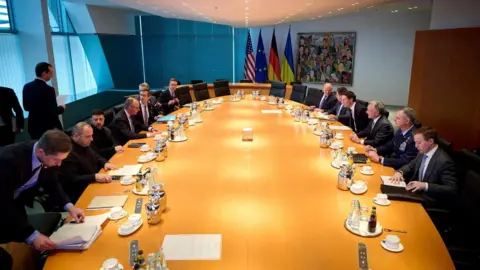
Zelensky and his chief negotiator Rustem Umerov met US envoy Steve Witkoff and Donald Trump's son-in-law Jared Kushner for five hours on Sunday, joined by German Chancellor Friedrich Merz.
A lot of progress was made, a US readout said. The same team resumed talks on Monday morning.
Ahead of the start of the meeting, Volodymyr Zelensky signalled he would give up ambitions to join NATO in exchange for security guarantees.
Recognising that some partners from the US and Europe did not support Ukraine's bid for NATO membership, Zelensky said he was instead seeking strong security guarantees modelled on NATO's Article 5 clause of mutual protection.
Witkoff has travelled to Moscow to hold talks with Vladimir Putin on several occasions, but Sunday's meeting at the chancellery in Berlin was the first time he met Zelensky. NATO Supreme Allied Commander Europe General Alexus Grynkewich was also present at the talks.
At the core of the discussions in Berlin is the 20-point peace plan proposal presented to the US by Ukraine last week to counter an initial American plan which was seen as heavily favouring Russia.
Before the talks began, Zelensky also addressed the thorny issue of sovereignty over the eastern region of the Donbas, which Russia mostly occupies and which it wants Kyiv to hand over in their entirety.
The talks in Berlin come at a crucial time for Ukraine, which is enduring its fourth winter of war amid sustained power cuts caused by Russia's attacks on its energy facilities.

