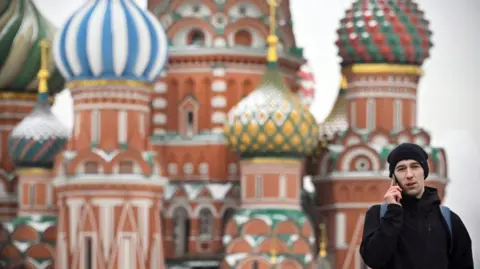
Russia has attempted to fully block WhatsApp in the country, the company stated, as the Kremlin continues to enforce stringent controls on messaging apps. Meta-owned WhatsApp claims that this strategy is aimed at shifting more than 100 million of its users towards a state-owned surveillance app. This escalation follows recent actions where Russian regulators limited access to Telegram, claiming security concerns, with Telegram's user base reportedly on par with WhatsApp's in Russia.
In a statement, WhatsApp denounced the move, asserting that isolating users from private and secure communication is a regressive step that would enhance safety risks for individuals in Russia. The company highlighted its ongoing efforts to maintain connectivity for its users. Meanwhile, Russia's communications regulator, Roskomnadzor, has repeatedly pressured WhatsApp to comply with local laws.
Reports suggest that WhatsApp could face permanent restrictions by 2026, as Russian officials argue that both WhatsApp and Telegram have failed to store Russian user data locally as mandated by legislative requirements. The Kremlin has also adopted severe measures to promote its communications platform, Max, which combines messaging with government services but lacks encryption, akin to China's WeChat.
Public sector employees, educators, and students are now mandated to use Max, which has been pre-installed on all new devices sold in Russia since 2025. Telegram's CEO criticized the state's approach as an attempt to coerce citizens into using a government-controlled app for surveillance and censorship.
This situation mirrors efforts in other nations, such as Iran, where similar tactics have been employed to suppress independent messaging platforms. Durov, the Telegram CEO, argued that limiting citizens' freedoms is never a viable solution and highlighted how circumventing such restrictions remains a priority for users.
In a statement, WhatsApp denounced the move, asserting that isolating users from private and secure communication is a regressive step that would enhance safety risks for individuals in Russia. The company highlighted its ongoing efforts to maintain connectivity for its users. Meanwhile, Russia's communications regulator, Roskomnadzor, has repeatedly pressured WhatsApp to comply with local laws.
Reports suggest that WhatsApp could face permanent restrictions by 2026, as Russian officials argue that both WhatsApp and Telegram have failed to store Russian user data locally as mandated by legislative requirements. The Kremlin has also adopted severe measures to promote its communications platform, Max, which combines messaging with government services but lacks encryption, akin to China's WeChat.
Public sector employees, educators, and students are now mandated to use Max, which has been pre-installed on all new devices sold in Russia since 2025. Telegram's CEO criticized the state's approach as an attempt to coerce citizens into using a government-controlled app for surveillance and censorship.
This situation mirrors efforts in other nations, such as Iran, where similar tactics have been employed to suppress independent messaging platforms. Durov, the Telegram CEO, argued that limiting citizens' freedoms is never a viable solution and highlighted how circumventing such restrictions remains a priority for users.