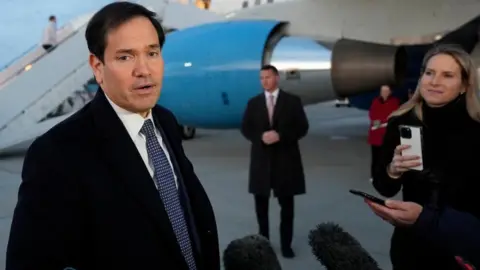
US Secretary of State Marco Rubio has spoken of a defining moment and a 'new era' as he travels to Europe for a major speech to the Munich Security Conference. Rubio will lead the US delegation at the first major global event since President Donald Trump threatened Danish sovereignty with a pledge to annex Greenland. French President Emmanuel Macron has insisted Europe must prepare for independence from the US, while NATO Secretary General Mark Rutte has stressed that transatlantic bonds are as close and important as ever. The war in Ukraine, tensions with China, and a potential nuclear deal between Iran and the US are also on the agenda as the security conference gets under way.
'The world is changing very fast right in front of us,' Rubio told reporters when asked if his message to Europeans would be more conciliatory than a year ago. 'We live in a new era in geopolitics, and it's going to require all of us to sort of re-examine what that looks like and what our role is going to be.' At last year's conference, US Vice-President JD Vance attacked Europe, including the UK, for policies on free speech and immigration, triggering unprecedented transatlantic tension.
Some 50 world leaders are set to attend the conference, which will discuss European defense and the future of the transatlantic relationship at a time when US commitments to NATO have been called into question. Tensions have been heightened in recent months as Trump has repeatedly said that Greenland is vital to US national security, stating without evidence that it was 'covered with Russian and Chinese ships all over the place.' Danish Prime Minister Mette Frederiksen told reporters on Friday she planned to meet with Rubio to discuss the US threats to seize Denmark's semi-autonomous territory.
The US threats have been viewed by many European leaders as a watershed moment that has eroded trust with its biggest ally. Ahead of the conference, eight former US ambassadors to NATO and eight former American supreme commanders in Europe issued an open letter calling for Washington to maintain its support for the Western defensive alliance, saying NATO was a 'force-multiplier' that allowed the US to assert its power and influence.
The transatlantic relationship has come under increasing strain following the Republican president's introduction of tariffs and suggestions that European nations may not remain 'reliable allies' in the long term. Conference Chairman Wolfgang Ischinger warned that the principles underpinning the international order are increasingly uncertain, raising difficult questions about the future shape of transatlantic cooperation. Rubio's expected more conciliatory approach comes amidst calls for unity and clarification of US intentions as the geopolitical landscape evolves.
'The world is changing very fast right in front of us,' Rubio told reporters when asked if his message to Europeans would be more conciliatory than a year ago. 'We live in a new era in geopolitics, and it's going to require all of us to sort of re-examine what that looks like and what our role is going to be.' At last year's conference, US Vice-President JD Vance attacked Europe, including the UK, for policies on free speech and immigration, triggering unprecedented transatlantic tension.
Some 50 world leaders are set to attend the conference, which will discuss European defense and the future of the transatlantic relationship at a time when US commitments to NATO have been called into question. Tensions have been heightened in recent months as Trump has repeatedly said that Greenland is vital to US national security, stating without evidence that it was 'covered with Russian and Chinese ships all over the place.' Danish Prime Minister Mette Frederiksen told reporters on Friday she planned to meet with Rubio to discuss the US threats to seize Denmark's semi-autonomous territory.
The US threats have been viewed by many European leaders as a watershed moment that has eroded trust with its biggest ally. Ahead of the conference, eight former US ambassadors to NATO and eight former American supreme commanders in Europe issued an open letter calling for Washington to maintain its support for the Western defensive alliance, saying NATO was a 'force-multiplier' that allowed the US to assert its power and influence.
The transatlantic relationship has come under increasing strain following the Republican president's introduction of tariffs and suggestions that European nations may not remain 'reliable allies' in the long term. Conference Chairman Wolfgang Ischinger warned that the principles underpinning the international order are increasingly uncertain, raising difficult questions about the future shape of transatlantic cooperation. Rubio's expected more conciliatory approach comes amidst calls for unity and clarification of US intentions as the geopolitical landscape evolves.