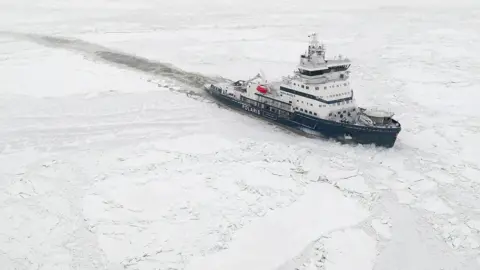
As President Donald Trump has underscored the importance of US ownership of Greenland, his administration's focus on the Arctic has led to the decision to acquire new icebreakers. For this endeavor, the US has turned to Finland, renowned for its expertise in icebreaker construction.
At the Aker Arctic Technology facility in Helsinki, tests on model icebreakers reveal the advanced design processes that characterize Finland’s icebreaking vessels. The company asserts that the structural integrity and engine power of these ships are paramount for efficiently navigating icy seas.
Finland has developed a reputation for being at the forefront of icebreaker technology, with Finnish companies accounting for the design of approximately 80% of the world's icebreakers. This expertise is vital for Finland, where the freezing of harbors every winter necessitates the use of icebreakers to ensure the flow of goods - an essential operation for this maritime nation.
Trump announced plans in October for the US Coast Guard to order four icebreakers from Finland, with an additional seven icebreakers to be built domestically based on Finnish designs. Trump's statement emphasized the enhanced maritime strength the US would gain through these vessels, which are deemed the finest in the world.
While the US navigates complex maritime laws regarding domestic shipbuilding, the current geopolitical climate, marked by perceived threats from Russia and China, has prompted exemptions to these regulations. As climate change continues to alter Arctic conditions, the strategic importance of this region grows, opening new trade routes and increasing traffic.
The difficulties posed by a limited number of operational US icebreakers, currently only three, stand in stark contrast to Russia’s expansive fleet of around 40, creating urgency within the US to enhance its capabilities.
In summary, the acquisition of Finnish icebreakers marks a significant shift in the US's Arctic strategy, aimed at countering increasing competition and ensuring national security interests are met in a rapidly changing geopolitical landscape.