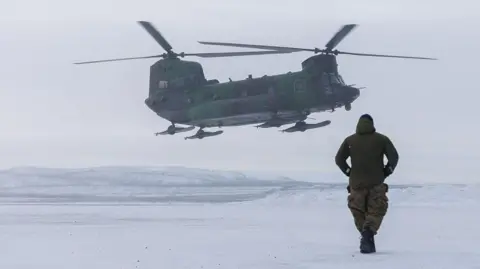
Canada's Arctic is a massive, treacherous, and largely inhospitable place, stretching over nearly 4 million square kilometers of territory with a small population comparable to Blackburn in England or Syracuse, New York.
You can take a map of continental Europe, put it on the Canadian Arctic, and there's room to spare, said Pierre Leblanc, the former commander of the Canadian Forces Northern Area. And that environment is extremely dangerous. The nation's defenses consist of aging radars, eight military bases, and about 100 full-time Coast Guard personnel covering 162,000km of its coast.
The Arctic region is a focal point of increasing geopolitical competition, bordered by Russia and the U.S. at the North Pole and attracting interest from China as a near Arctic state. Nearly four years after the spotlight turned on Arctic security due to Russia's invasion of Ukraine, Canada's strategic importance is more pronounced, highlighted by former President Trump’s interest in Greenland as a key to U.S. security.
In response, the Canadian government is working to enhance security, recently announcing unprecedented investments in radar systems, submarines, and air capabilities. Prime Minister Mark Carney emphasized the importance of collaboration with NATO allies to safeguard Canadian interests in the Arctic.
This focus on defense is echoed by Col. Leblanc, who noted that the increase in defense spending signifies a shift in how Canada addresses Arctic security, raising expenditures from 2% to 5% of GDP by 2035.
However, challenges remain, including the need for modernized infrastructure that can counter new threats like hypersonic missiles. Experts highlight that the current defense system is not equipped to handle such rapid threats, necessitating over-the-horizon radar and improvements in cooperation between Canada and the U.S.
As Canadian officials navigate these geopolitical pressures, the collaboration between U.S. and Canadian forces on the ground continues, with practitioners optimistic despite political rhetoric. The relationship's future hinges on adapting to emerging defense needs while responding to both American interest and challenges arising from Arctic rivals.