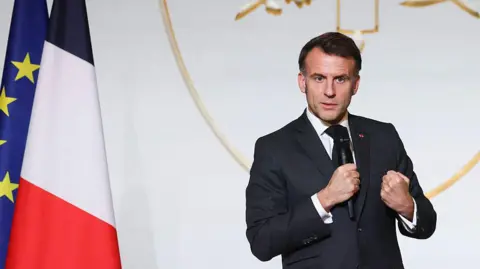
The EU's top diplomat has called Moscow's claims that Ukraine targeted Russian government sites a deliberate distraction and an attempt to derail the peace process.
Kaja Kallas' comments on social media appear to be a reference to the Kremlin's allegation that Ukraine attempted a drone strike on one of Vladimir Putin's residences.
No one should accept unfounded claims from the aggressor who has indiscriminately targeted Ukraine's infrastructure and civilians, Kallas wrote on social media.
Earlier this week Moscow accused Ukraine of targeting Putin's private home on Lake Valdai in north-west Russia.
Russia would review its position in the ongoing peace negotiations as a result, the Kremlin said.
Since Foreign Minister Sergei Lavrov first shared the claims, Russian state media and politicians have discussed the alleged attack in increasingly incendiary tones.
The attack is a strike on the heart of Russia, said Andrei Kartapolov, head of the Russian parliament's defence committee. After what [Ukraine] has done, there can be no forgiveness.
Although the Kremlin initially said it saw no point in sharing proof of the alleged attack, on Wednesday the Russian army released what it said was evidence of the attempted strike.
It included a map allegedly showing that the drones were launched from the Sumy and Chernihiv regions of Ukraine and a video of a downed drone lying in snowy woodland. A serviceman standing next to the wreckage claims it is a Ukrainian Chaklun drone.
The BBC hasn't been able to verify the footage, and it is not possible to locate where it was shot.
The profile of the wrecked UAV (unmanned aerial vehicle) does bear similarities to Ukrainian-produced Chakluns – but because the components of the drone pictured are inexpensive and widely available online, they cannot be conclusively traced to the Ukrainian military.
Russia's defence ministry also released a video of what it said was a local resident who described hearing noises like a rocket at the time of the alleged attack.
However, one Russian investigative media outlet said it had spoken to more than a dozen residents of the area around Putin's residence and none had heard anything that could indicate 91 drones had approached or been shot down by air defences.
Ukrainian President Volodymyr Zelensky has strenuously denied the allegations, tying them to the ongoing US-led process to reach a ceasefire in Ukraine.
In his view, the claims about the drone attack on Putin's Valdai residence were about the fact that over the past month there were quite successful talks and a positive meeting between our teams, culminating in our meeting with President Trump.
Zelensky asserted that Russia wanted to disrupt the positive momentum between the US and Ukraine.
When the claims emerged, Zelensky also warned that the alleged drone strike would be used as an excuse to carry out strikes on Kyiv and Ukrainian government buildings. Overnight on Wednesday air alerts briefly rang out in the capital as a drone approached, but no hits or damage were reported.
Instead, several locations across the country were hit by drones and Odesa on the Black Sea suffered a large-scale attack which saw an apartment block hit and six people injured, including three children. More than 170,000 were also left without power.
Odesa has been coming under sustained attack for several weeks. The intensity of the strikes appears to have increased since Putin's threat in early December to cut off Ukraine's access to the sea in retaliation for drone attacks on tankers of Russia's shadow fleet in the Black Sea.
As the year comes to an end, many in Kyiv hope for peace and reflect on the ongoing war's impact on their lives. Zelensky continues to express a desire for resumed negotiations, but the current climate raises doubts about reaching a successful resolution.