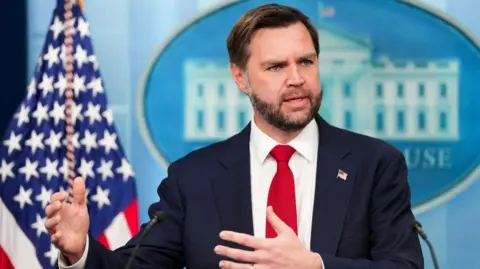
US Treasury Secretary Scott Bessent has told the BBC a small bit of economic pain is worthwhile for long-term international security.
As the International Monetary Fund (IMF) warned the US-Israel war with Iran could plunge the global economy into recession, Bessent said the conflict was to eliminate the threat of Iranian nuclear strikes on Western capitals.
I wonder what the hit to global GDP would be if a nuclear weapon hit London... I am saying that I am less concerned about short-term forecasts, for long-term security, he said.
At the start of the war, Iran had uranium enriched to 60%, according to senior US officials. It does not have nuclear weapons.
The UK government has said there is no assessment that Iran is trying to target Europe with missiles.
Bessent expressed that he prioritizes tackling the Iranian nuclear threat over immediate economic impacts, asserting, The biggest risk you can take is one you don't know you were taking. He referenced that Iran possesses mid-range intercontinental ballistic missiles and has ambitions for a nuclear program.
He added that US and Israeli strikes had removed the tail risk of Iranian nuclear strikes against Western countries. As the BBC previously reported, the threat of Iranian ballistic missiles to London is remote.
A UK government spokesperson stated, There is no assessment Iran is trying to target Europe with missiles. But we have the military capability we need to keep Britain safe from any kind of attacks, whether it's on our soil or from abroad. We are ready to defend the country, whatever the threat.
In its World Economic Outlook report, the IMF indicated that, in a worst-case scenario where oil, gas, and food prices spike, global growth could fall below 2% in 2026, posing a close call for a global recession, last seen during the Covid pandemic.
Energy prices have soared since the war began, affecting the global economy and threatening economic stability.
The IMF anticipated that severe conditions could lead to inflation rates as high as 6% across global economies, potentially triggering interest rate hikes by central banks aimed at curbing price increases.
Despite these challenges, Bessent maintains that the collective security measures against Iran's threats should take precedence over incidental economic downturns.