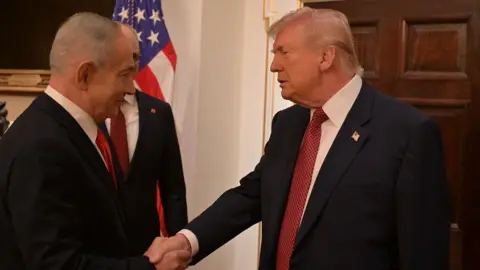
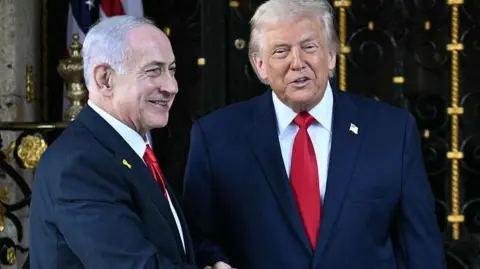
Israeli Prime Minister Benjamin Netanyahu has convened a meeting with his top advisers to discuss Donald Trump's 'Board of Peace' for Gaza, following the revelation that the United States did not include Israel in discussions related to its creation.
Netanyahu's office stated the initiative was 'not coordinated with Israel and runs contrary to its policy', reacting to the Saturday announcement of the committee’s Gaza Executive Board which features the Turkish foreign minister, a Qatari official, former UK Prime Minister Tony Blair, and Trump’s son-in-law, Jared Kushner.
The Board of Peace, as part of Trump’s 20-point plan to resolve the Israel-Hamas conflict, is expected to temporarily oversee Gaza’s governance and reconstruction, but its structure remains ambiguous, with members still being selected.
Two separate senior bodies operating under the main Board of Peace were introduced—one focusing on high-level investment and diplomacy termed the 'founding Executive Board', and the other, the 'Gaza Executive Board', which is tasked with managing on-the-ground operations through the National Committee for the Administration of Gaza (NCAG).
Currently, the only Israeli member on the Gaza Executive Board is Yakir Gabay, a businessman originally from Israel now based in Cyprus, with no Palestinians represented on either board.
National Security Minister Itamar Ben-Gvir remarked on X that the Gaza Strip requires liberation from Hamas rather than administrative oversight for rehabilitation, while opposition leader Yair Lapid has characterized the announcement as a 'diplomatic failure for Israel'.
The Board of Peace is anticipated to include several world leaders, with Trump at the helm. While the specific members have yet to be disclosed, reports suggest that invitations have been sent to leaders from countries such as the UK, Hungary, Argentina, Jordan, Turkey, India, and Egypt.
The White House plans for these members to ensure effective governance and superior services aimed at fostering peace and stability in Gaza.
Reports from Saturday indicated Trump is seeking substantial contributions—specifically $1 billion— from countries wishing to join the panel, although a US official clarified that nations could participate for three years without a financial burden.
The UN has flagged that the humanitarian crisis in Gaza is far from being resolved, estimating that around 80% of its buildings have been damaged or destroyed, with families now facing harsh winter conditions alongside food shortages.
Israel claims it is aiding humanitarian efforts, while accusing the UN of inadequate distribution of supplies within Gaza. The ongoing tensions between these developments underline deep-seated concerns regarding security and future governance in the region.