Donald Trump's warning that the US will intervene if peaceful protesters are killed was 'reckless and dangerous', Iran's foreign minister has said.
Abbas Araghchi's comments came after the US president said Washington 'will come to their rescue' of demonstrators taking part in protests over Iran's economy, writing in a brief social media post: 'We are locked and loaded and ready to go.'
Araghchi indicated Iran's armed forces were on standby and 'know exactly where to aim' in the event of an attack.
At least eight people are reported to have died during the week-long protests, as of Saturday morning. Trump wrote on Friday: 'If Iran shots and violently kills peaceful protesters, which is their custom, the United States of America will come to their rescue.'
The US president did not specify what action Washington might take. Previously, it has carried out strikes on Iran's nuclear sites, which elicited a retaliatory strike on a US base in Qatar.
'Given President Trump's deployment of the National Guard within US borders, he of all people should know that criminal attacks on public property cannot be tolerated,' Araghchi wrote on X.
Iran would 'forcefully reject any interference in their internal affairs', he added.
On Saturday Iran's Supreme Leader Ayatollah Ali Khamenei addressed the wave of protests, saying that 'rioters must be put in their place'. He said shopkeepers' original protest about the collapse in foreign exchange rates was 'legitimate', but he claimed people 'provoked by the enemy' were taking advantage to shout anti-government slogans.
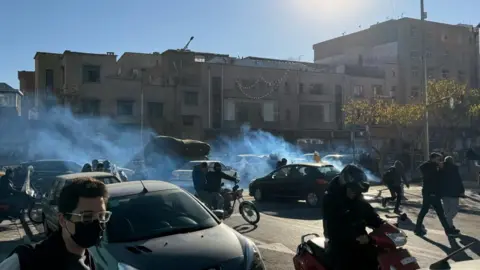
Protests have spread to a number of cities and towns with running battles reported between security forces and demonstrators. On Saturday the state-affiliated Mehr and Fars news agencies reported that two protesters and a member of the security forces were killed in the western town of Malekshahi when, they said, protesters tried to enter a police station.
The EU said it was 'concerned' by reports of deaths and called for Tehran to exercise 'maximum restraint' against the protesters as well as upholding their right to 'freedom of expression, association and peaceful assembly'.
The protests began in Tehran, with shopkeepers angered by another sharp fall in the value of the Iranian currency, the rial, against the US dollar on the open market. By Tuesday, university students were involved and the protests had spread to several cities, with people chanting against the country's clerical rulers.
Two people have since died in clashes between protesters and security forces in the south-western city of Lordegan, according to the semi-official Fars news agency and the human rights group Hengaw, which said they were protesters, naming them as Ahmad Jalil and Sajjad Valamanesh.
Three people were killed in Azna, while another died in Kouhdasht, all in the west of the country, Fars reported. It did not specify whether they were demonstrators or security forces personnel. One death was reported in Fuladshahr, central Iran, and another casualty in Marvdasht, in the south.
BBC has not been able to independently verify the deaths.
The demonstrations have been the most widespread since an uprising in 2022 sparked by the death in custody of Mahsa Amini, a young woman accused by morality police of not wearing her veil properly, but they have not been on the same scale. Iranian President Masoud Pezeshkian has previously said he will listen to the 'legitimate demands' of the protesters.
Abbas Araghchi's comments came after the US president said Washington 'will come to their rescue' of demonstrators taking part in protests over Iran's economy, writing in a brief social media post: 'We are locked and loaded and ready to go.'
Araghchi indicated Iran's armed forces were on standby and 'know exactly where to aim' in the event of an attack.
At least eight people are reported to have died during the week-long protests, as of Saturday morning. Trump wrote on Friday: 'If Iran shots and violently kills peaceful protesters, which is their custom, the United States of America will come to their rescue.'
The US president did not specify what action Washington might take. Previously, it has carried out strikes on Iran's nuclear sites, which elicited a retaliatory strike on a US base in Qatar.
'Given President Trump's deployment of the National Guard within US borders, he of all people should know that criminal attacks on public property cannot be tolerated,' Araghchi wrote on X.
Iran would 'forcefully reject any interference in their internal affairs', he added.
On Saturday Iran's Supreme Leader Ayatollah Ali Khamenei addressed the wave of protests, saying that 'rioters must be put in their place'. He said shopkeepers' original protest about the collapse in foreign exchange rates was 'legitimate', but he claimed people 'provoked by the enemy' were taking advantage to shout anti-government slogans.
Protests have spread to a number of cities and towns with running battles reported between security forces and demonstrators. On Saturday the state-affiliated Mehr and Fars news agencies reported that two protesters and a member of the security forces were killed in the western town of Malekshahi when, they said, protesters tried to enter a police station.
The EU said it was 'concerned' by reports of deaths and called for Tehran to exercise 'maximum restraint' against the protesters as well as upholding their right to 'freedom of expression, association and peaceful assembly'.
The protests began in Tehran, with shopkeepers angered by another sharp fall in the value of the Iranian currency, the rial, against the US dollar on the open market. By Tuesday, university students were involved and the protests had spread to several cities, with people chanting against the country's clerical rulers.
Two people have since died in clashes between protesters and security forces in the south-western city of Lordegan, according to the semi-official Fars news agency and the human rights group Hengaw, which said they were protesters, naming them as Ahmad Jalil and Sajjad Valamanesh.
Three people were killed in Azna, while another died in Kouhdasht, all in the west of the country, Fars reported. It did not specify whether they were demonstrators or security forces personnel. One death was reported in Fuladshahr, central Iran, and another casualty in Marvdasht, in the south.
BBC has not been able to independently verify the deaths.
The demonstrations have been the most widespread since an uprising in 2022 sparked by the death in custody of Mahsa Amini, a young woman accused by morality police of not wearing her veil properly, but they have not been on the same scale. Iranian President Masoud Pezeshkian has previously said he will listen to the 'legitimate demands' of the protesters.