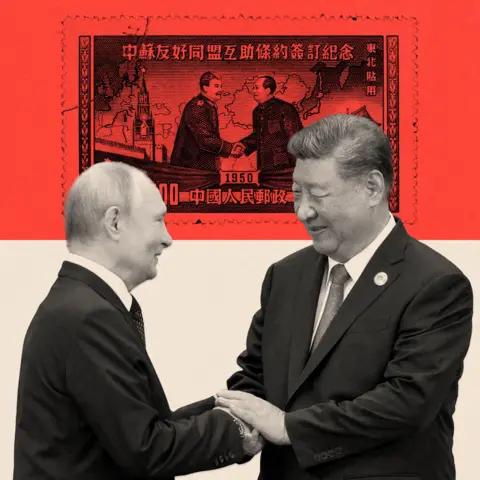
As they strolled through Tiananmen Square in Beijing last September, Chinese President Xi Jinping and Russian President Vladimir Putin engaged in a philosophical discussion about the possibilities of human longevity through organ transplantation. Such conversations are rare but provide a glimpse into the nuanced relationship between these two leaders.
Despite being often labeled as authoritarian allies against the West, the China-Russia partnership is characterized by its asymmetry. While China can largely dictate trade terms due to its significantly larger economy, Russia relies on Beijing as its chief economic partner, especially in the wake of western sanctions.
On Chinese Terms
The imbalance in this relationship prompts discussions about the balance of power. Alexander Gabuev from the Carnegie Russia Eurasia Center noted, Russia is fully in China's pocket, and China can dictate the terms. This dynamic manifests in numerous areas, particularly in technology, where Chinese companies like Huawei have filled gaps left by Western firms.
Partners, Not Allies
It's crucial to recognize that, while both countries share vital interests, they do not operate as a formal alliance. Analyst Bobo Lo points out their partnership is flexible by nature, enabling both nations to navigate their differences without adhering strictly to a militaristic framework.
Both countries maintain a shared border of 4,300 kilometers and align against a common U.S.-led world order. They do not criticize each other's internal matters, allowing a mutual cushion against external pressures.
The Human Connection
On a societal level, the relationship has been growing. Travel between the two countries has become easier, and Russians are increasingly adopting Chinese technology in everyday life. This interconnectedness may enhance bilateral ties despite geopolitical tensions.
Ultimately, the continuation of the China-Russia relationship hinges on their recognition of its importance amidst an evolving global landscape, as they remain intertwined to an extent that makes separation impractical in the near future.