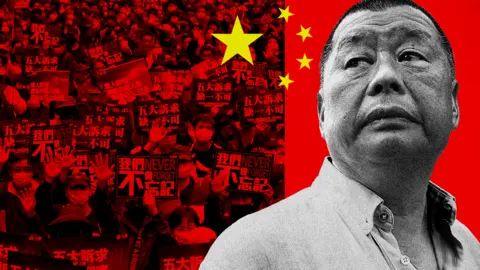
On a winter morning in 2022, Raphael Wong and Figo Chan walked into Hong Kong's Stanley prison to meet Jimmy Lai, the media billionaire who had been arrested two years before and was awaiting trial charged with national security offences.
They had all been part of the turbulent protests that had rocked Hong Kong in 2019, when hundreds of thousands took to the streets demanding democracy and more freedom in the Chinese territory.
In prison, Lai had lost considerable weight, a far cry from his previous persona as the irreverently nicknamed Fatty Lai.
Throughout his life, Lai had been a key figure in the fight for democracy, using his influential newspaper, Apple Daily, to advocate for a liberal Hong Kong. However, his activism brought about significant risks, particularly under the controversial national security law passed by the Chinese Communist Party in 2020.
Lai famously refused to leave Hong Kong despite his British citizenship, stating, I got everything I have because of this place. This commitment to his homeland fueled his political stance, which vehemently opposed the Communist Party's control.
The High Court recently ruled against Lai, stating that he had a rabid hatred of the Chinese Communist Party and was guilty on all counts of colluding with foreign forces. During his trial, Lai maintained that he only advocated for values he believed in: rule of law, freedom, and democracy.
His case is emblematic of a wider crackdown on dissent in Hong Kong, where many activists now face imprisonment or exile. Lai's journey captures the intersection of personal sacrifice and the struggle for democracy in a city long known for its freedoms.
As the landscape in Hong Kong continues to shift, many wonder if the city Lai once knew, vibrant and filled with dissent, still has a place for a figure like him. His family has called for his release, citing health concerns, while critics point to the government's growing authoritarianism.