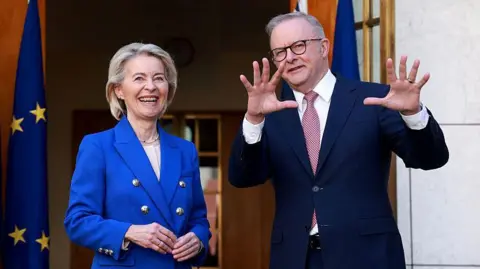
Australia and the European Union have agreed a sweeping free trade deal after eight years of negotiations. The deal signed in Canberra is worth about A$10bn ($7bn; £5.2bn) and was described as a mutual win-win by Australia's Prime Minister Anthony Albanese and EU Commission President Ursula von der Leyen.
She emphasized the agreement's focus on collective resilience in a changing global landscape. Nearly all tariffs on trade will be removed, and both sides will enhance cooperation in defense and critical minerals.
While European carmakers welcomed the pact, Australian farmers expressed dissatisfaction with the limited export quotas for beef and lamb, pointing out that while permitted amounts of Australian beef will increase significantly, it falls short of farmer expectations.
The deal further aims to diversify trade relationships amid evolving geopolitical dynamics, particularly with uncertainties concerning U.S. trade policies.
In the context of food and agricultural products, the agreement lifts most EU tariffs on Australian exports including wine and dairy, strategically benefitting local producers and offering Australians lower prices on European goods. The relationship reinforced by this deal is asserted by von der Leyen to be built for the long term, striving to mitigate vulnerabilities presented by global power dynamics.
She emphasized the agreement's focus on collective resilience in a changing global landscape. Nearly all tariffs on trade will be removed, and both sides will enhance cooperation in defense and critical minerals.
While European carmakers welcomed the pact, Australian farmers expressed dissatisfaction with the limited export quotas for beef and lamb, pointing out that while permitted amounts of Australian beef will increase significantly, it falls short of farmer expectations.
The deal further aims to diversify trade relationships amid evolving geopolitical dynamics, particularly with uncertainties concerning U.S. trade policies.
In the context of food and agricultural products, the agreement lifts most EU tariffs on Australian exports including wine and dairy, strategically benefitting local producers and offering Australians lower prices on European goods. The relationship reinforced by this deal is asserted by von der Leyen to be built for the long term, striving to mitigate vulnerabilities presented by global power dynamics.