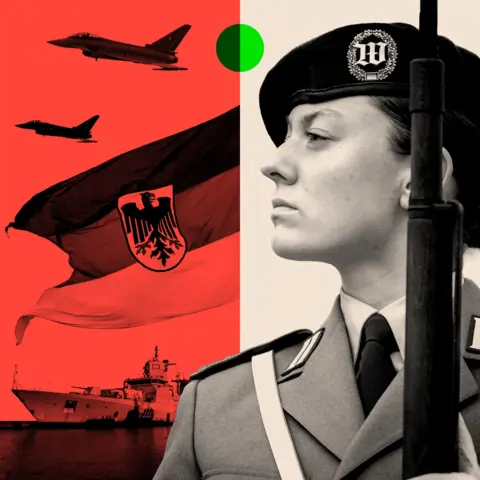
General Carsten Breuer is a man in a hurry. As the head of Germany's armed forces, he's tasked with rapidly expanding the army into Europe’s most formidable military force. Breuer's concern centers on Russia’s ongoing military build-up, which he predicts may empower it to attack NATO nations by 2029. Breuer insists, 'I've never experienced a situation which is as dangerous, as urgent, as it is today.' To respond, Germany is projected to spend €162 billion on its military by 2029, a significant increase from previous years.
Historically, Germany's post-war military efforts have been met with skepticism from its neighbors due to the country's wartime legacy. However, the rearmament under Breuer seeks to establish Germany as a cooperative ally rather than an aggressor. He has revealed a vision to augment the armed forces by 20,000 personnel by next year, aiming to reach an overall force of 242,000 by 2035. Public support for military investment is rising, increasing from historically low levels.
Germany now maintains troops in Lithuania, signifying a strategic shift that acknowledges past fears while embracing collaboration within NATO. The military exercises conducted near the Russia-Belarus border reflect Germany's proactive stance in counteracting potential threats. Meanwhile, amid a global reassessment of defense stances, other European nations are also planning to increase their military budgets, directly responding to the challenges Moscow presents.
This sweeping change, described as a 'cultural revolution' by experts, is emblematic of Germany's transformation in light of Kremlin ambitions. Breuer is adamant: 'What I'm doing is to prepare Germany to be able to defend itself... This is deterrence for us. We will deter the threat from the Russian side.' Germany’s new approach not only charts a fresh course for its military but seeks to secure its standing as a prominent European leader in defense strategies.
Historically, Germany's post-war military efforts have been met with skepticism from its neighbors due to the country's wartime legacy. However, the rearmament under Breuer seeks to establish Germany as a cooperative ally rather than an aggressor. He has revealed a vision to augment the armed forces by 20,000 personnel by next year, aiming to reach an overall force of 242,000 by 2035. Public support for military investment is rising, increasing from historically low levels.
Germany now maintains troops in Lithuania, signifying a strategic shift that acknowledges past fears while embracing collaboration within NATO. The military exercises conducted near the Russia-Belarus border reflect Germany's proactive stance in counteracting potential threats. Meanwhile, amid a global reassessment of defense stances, other European nations are also planning to increase their military budgets, directly responding to the challenges Moscow presents.
This sweeping change, described as a 'cultural revolution' by experts, is emblematic of Germany's transformation in light of Kremlin ambitions. Breuer is adamant: 'What I'm doing is to prepare Germany to be able to defend itself... This is deterrence for us. We will deter the threat from the Russian side.' Germany’s new approach not only charts a fresh course for its military but seeks to secure its standing as a prominent European leader in defense strategies.