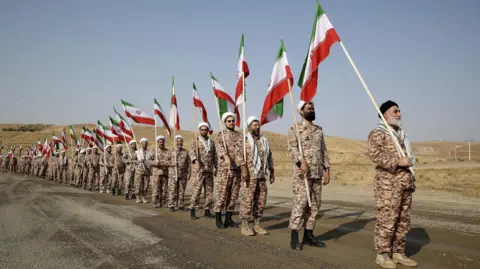
The European Union has added Iran's Islamic Revolutionary Guard Corps (IRGC) to its terrorist list in response to Tehran's deadly crackdown on protesters in recent weeks. The bloc's top diplomat Kaja Kallas stated that EU foreign ministers took this decisive step because 'repression cannot go unanswered.' This designation places the IRGC, a major military, economic, and political force in Iran, on par with jihadist organizations such as al-Qaeda and the Islamic State group.
Human rights groups report that thousands of protesters have been killed by security forces, including the IRGC, during unrest in December and January. French Foreign Minister Jean-Noel Barrot characterized the situation as 'the most violent repression in Iran's modern history,' emphasizing the need for accountability.
The decision from Brussels follows a shift in France's stance, which previously hesitated to blacklist the IRGC due to concerns over diplomatic relations with Iran. However, following discussions led by Italy, France supported the initiative strongly.
Kaldas noted that while the IRGC is now listed among terrorist groups, diplomatic channels with Iran would remain open. The EU also instituted new sanctions against six entities and fifteen individuals linked to the violent suppression of protests.
Organizations on the EU's terrorist list face various sanctions, such as travel bans and asset freezes, aimed at dismantling their operational support networks.
This marks a continuation of efforts from other Western nations, including the US, Canada, and Australia, which have already designated the IRGC as a terrorist organization, although it remains unclassified as such in the UK.
Human rights groups report that thousands of protesters have been killed by security forces, including the IRGC, during unrest in December and January. French Foreign Minister Jean-Noel Barrot characterized the situation as 'the most violent repression in Iran's modern history,' emphasizing the need for accountability.
The decision from Brussels follows a shift in France's stance, which previously hesitated to blacklist the IRGC due to concerns over diplomatic relations with Iran. However, following discussions led by Italy, France supported the initiative strongly.
Kaldas noted that while the IRGC is now listed among terrorist groups, diplomatic channels with Iran would remain open. The EU also instituted new sanctions against six entities and fifteen individuals linked to the violent suppression of protests.
Organizations on the EU's terrorist list face various sanctions, such as travel bans and asset freezes, aimed at dismantling their operational support networks.
This marks a continuation of efforts from other Western nations, including the US, Canada, and Australia, which have already designated the IRGC as a terrorist organization, although it remains unclassified as such in the UK.