Police in Greece have been recruiting migrants to violently push other migrants back across its land border with Turkey, according to wide-ranging evidence uncovered by the BBC. We have seen internal police documents in which guards describe how the recruitment of so-called mercenaries was ordered and overseen by senior officers.
Our findings reveal allegations of brutality, with witnesses reporting migrants being stripped, robbed, beaten, and even sexually assaulted. It has been claimed that mercenaries have been unofficially employed on the border since at least 2020.
The Greek prime minister told the BBC he was totally unaware about allegations of the use of migrants for pushbacks, while the country's authorities have not responded to our written detailed requests for comment.
Pushbacks—forcing migrants and asylum seekers back across borders without due process—are generally considered illegal under international law.
Claims that they were being carried out in Greece by foreign masked men were reported in 2022 by the Netherlands-based news organization, Lighthouse Reports.
Our own investigation—carried out in collaboration with the Consolidated Rescue Group (CRG)—began last autumn, when we were sent disturbing video allegedly showing migrants being mistreated by mercenaries. It was shared with us by a smuggler, who claimed to have become disgruntled with his associates. We have not been able to verify the content but it mirrors accounts we have gathered from other independent sources.
We have since pieced together information from migrants, former mercenaries, police sources, official documents, and leaked transcripts:
- One border guard told a disciplinary hearing they had information, reported to their superiors, that mercenaries had been raping female migrants.
- Two migrants and an ex-mercenary say they saw extreme violence by both mercenaries and Greek police, including people being beaten until they passed out.
- A migrant says a masked man took off her daughter's nappy in the hunt for valuables.
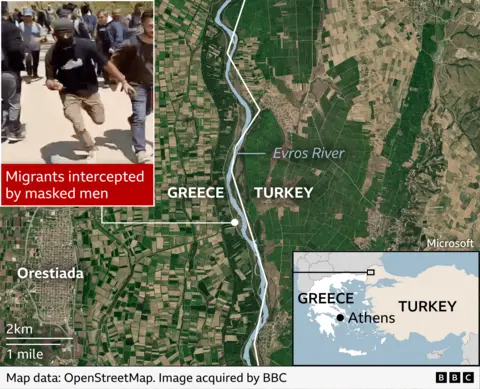
Greece has seen well over a million migrant arrivals since 2015—chiefly through sea crossings but also along its land border with Turkey. This frontier runs 200km (124 miles) along the Evros River, marking the outer edge of the European Union, separating Greece's Evros region from Turkey's East Thrace.
Refugees or illegal migrants crossing the river into Greece enter a heavily militarized restricted zone, dotted with watchtowers. A police source in the region told us that mercenaries have been used to push back as many as hundreds of people a week.
There is no soldier, police officer, or Frontex (EU border agency) officer serving here in Evros who does not know that pushbacks are taking place, they added.
We have found that the mercenaries are themselves migrants, recruited from countries including Pakistan, Syria, and Afghanistan, and that they can be rewarded with cash and mobiles looted from other migrants, as well as papers that, in effect, allow passage through Greece.
The BBC has been shown footage from June 22, 2023, in which a group of migrants, who had just crossed into Evros and wanted to claim asylum, were ambushed by masked men. A report into this incident by the Fundamental Rights Office, an independent investigator within Frontex, found that—based on the available evidence—between 10 and 20 third-country nationals had been acting under the instruction of Greek officers, subjecting migrants to physical and verbal abuse, including death and rape threats, as well as beating, stabbing, restraining, and theft of personal property. The report indicated that the migrants were then forcibly transported back to Turkey, in violation of EU human rights law.
These allegations point to potential abuses of human rights within a framework characterized by secrecy, violence, and systemic oversight by authorities. The narrative revealed herein paints a troubling picture of how migrant flows are managed at the borders of Europe, where legality and morality seem to be compromised by the imperatives of national security and border control.
Our findings reveal allegations of brutality, with witnesses reporting migrants being stripped, robbed, beaten, and even sexually assaulted. It has been claimed that mercenaries have been unofficially employed on the border since at least 2020.
The Greek prime minister told the BBC he was totally unaware about allegations of the use of migrants for pushbacks, while the country's authorities have not responded to our written detailed requests for comment.
Pushbacks—forcing migrants and asylum seekers back across borders without due process—are generally considered illegal under international law.
Claims that they were being carried out in Greece by foreign masked men were reported in 2022 by the Netherlands-based news organization, Lighthouse Reports.
Our own investigation—carried out in collaboration with the Consolidated Rescue Group (CRG)—began last autumn, when we were sent disturbing video allegedly showing migrants being mistreated by mercenaries. It was shared with us by a smuggler, who claimed to have become disgruntled with his associates. We have not been able to verify the content but it mirrors accounts we have gathered from other independent sources.
We have since pieced together information from migrants, former mercenaries, police sources, official documents, and leaked transcripts:
- One border guard told a disciplinary hearing they had information, reported to their superiors, that mercenaries had been raping female migrants.
- Two migrants and an ex-mercenary say they saw extreme violence by both mercenaries and Greek police, including people being beaten until they passed out.
- A migrant says a masked man took off her daughter's nappy in the hunt for valuables.
Greece has seen well over a million migrant arrivals since 2015—chiefly through sea crossings but also along its land border with Turkey. This frontier runs 200km (124 miles) along the Evros River, marking the outer edge of the European Union, separating Greece's Evros region from Turkey's East Thrace.
Refugees or illegal migrants crossing the river into Greece enter a heavily militarized restricted zone, dotted with watchtowers. A police source in the region told us that mercenaries have been used to push back as many as hundreds of people a week.
There is no soldier, police officer, or Frontex (EU border agency) officer serving here in Evros who does not know that pushbacks are taking place, they added.
We have found that the mercenaries are themselves migrants, recruited from countries including Pakistan, Syria, and Afghanistan, and that they can be rewarded with cash and mobiles looted from other migrants, as well as papers that, in effect, allow passage through Greece.
The BBC has been shown footage from June 22, 2023, in which a group of migrants, who had just crossed into Evros and wanted to claim asylum, were ambushed by masked men. A report into this incident by the Fundamental Rights Office, an independent investigator within Frontex, found that—based on the available evidence—between 10 and 20 third-country nationals had been acting under the instruction of Greek officers, subjecting migrants to physical and verbal abuse, including death and rape threats, as well as beating, stabbing, restraining, and theft of personal property. The report indicated that the migrants were then forcibly transported back to Turkey, in violation of EU human rights law.
These allegations point to potential abuses of human rights within a framework characterized by secrecy, violence, and systemic oversight by authorities. The narrative revealed herein paints a troubling picture of how migrant flows are managed at the borders of Europe, where legality and morality seem to be compromised by the imperatives of national security and border control.