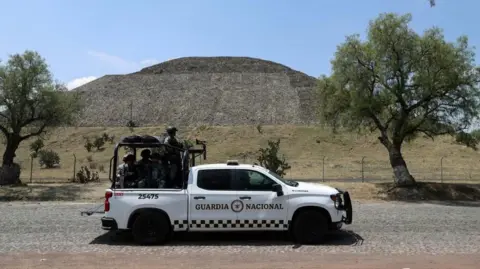
The authorities in Mexico are still piecing together how a typical morning at the ancient pyramid complex of Teotihuacán, one of the country's foremost tourist destinations, descended into terrifying gun violence on Monday.
The video footage is disturbing. A gunman stands atop the imposing Pyramid of the Moon and opens fire on the tourists around him, who cower for cover among the pre-Hispanic stone structures.
After the ordeal, a 32-year-old Canadian woman had been killed and the gunman had died from a self-inflicted gun wound. Tourists from several nations, including Russia, Colombia, and Brazil, were treated for their injuries in local hospitals. The fact that visitors from overseas were targeted poses a headache for the government just weeks before Mexico co-hosts the men's football World Cup.
The shooting came less than two months after masked gunmen from the Jalisco New Generation Cartel unleashed a wave of violence, sowing fear across the country following the killing of their leader 'El Mencho' by the security forces. But this incident was very different.
Mexican authorities say the Teotihuacán gunman acted alone and there was no apparent link to Mexico's widespread cartel violence. He has been identified as 27-year-old Julio César Jasso Ramírez, a Mexican citizen who lived in Mexico City. The aggressor planned and carried out the attack on his own and there is absolutely no indication at this point that he had any external help or that any other individuals were involved in this incident, said the Attorney-General of Mexico State José Luis Cervantes Martínez.
Among the gunman's belongings, officials found a handgun, a bag of cartridges, and a tactical knife. Officials also located literature, images, manuscripts apparently related to acts of violence which are known may have occurred in the United States in April 1999. A witness reported that visitors had heard the attacker reference Columbine, a notorious US school shooting from twenty-seven years ago.
Mexicans are no strangers to violence; some of the most atrocious massacres of this century in the Americas have been carried out on Mexican soil, generally between rival drug cartels. However, the shooting at Teotihuacán appears to fall into a very different category altogether, that of mass killings carried out by lone assailants without apparent links to established criminal organisations.
Attorney-General Cervantes indicated a psychopathic profile of the attacker, characterised by a tendency to imitate situations that occurred in other places, dubbed copycat behaviour. This comes just weeks after a teenager killed two teachers with an AR-15 assault rifle at his school in Michoacán, another deeply unusual incident in Mexican society.
Valeria Villa, a Mexican family therapist, described the current situation as a transition toward imitating mass killings seen daily in the United States. While guns in Mexico are not accessible over the counter as easily as in the US, weapons can still be obtained on the black market, often smuggled from the United States.
Amidst the turbulence, President Claudia Sheinbaum recently praised her federal security measures, noting a 44% reduction in daily homicide rates. However, critics point out that the murder statistics do not tell the complete story, as disappearances among young people remain a persistent issue.
Sheinbaum quickly offered sympathies for the victims after the shooting and assured World Cup attendees of their safety. Nonetheless, footage of the gunman firing at tourists from the Pyramid will likely exacerbate concerns ahead of the imminent international event.
The video footage is disturbing. A gunman stands atop the imposing Pyramid of the Moon and opens fire on the tourists around him, who cower for cover among the pre-Hispanic stone structures.
After the ordeal, a 32-year-old Canadian woman had been killed and the gunman had died from a self-inflicted gun wound. Tourists from several nations, including Russia, Colombia, and Brazil, were treated for their injuries in local hospitals. The fact that visitors from overseas were targeted poses a headache for the government just weeks before Mexico co-hosts the men's football World Cup.
The shooting came less than two months after masked gunmen from the Jalisco New Generation Cartel unleashed a wave of violence, sowing fear across the country following the killing of their leader 'El Mencho' by the security forces. But this incident was very different.
Mexican authorities say the Teotihuacán gunman acted alone and there was no apparent link to Mexico's widespread cartel violence. He has been identified as 27-year-old Julio César Jasso Ramírez, a Mexican citizen who lived in Mexico City. The aggressor planned and carried out the attack on his own and there is absolutely no indication at this point that he had any external help or that any other individuals were involved in this incident, said the Attorney-General of Mexico State José Luis Cervantes Martínez.
Among the gunman's belongings, officials found a handgun, a bag of cartridges, and a tactical knife. Officials also located literature, images, manuscripts apparently related to acts of violence which are known may have occurred in the United States in April 1999. A witness reported that visitors had heard the attacker reference Columbine, a notorious US school shooting from twenty-seven years ago.
Mexicans are no strangers to violence; some of the most atrocious massacres of this century in the Americas have been carried out on Mexican soil, generally between rival drug cartels. However, the shooting at Teotihuacán appears to fall into a very different category altogether, that of mass killings carried out by lone assailants without apparent links to established criminal organisations.
Attorney-General Cervantes indicated a psychopathic profile of the attacker, characterised by a tendency to imitate situations that occurred in other places, dubbed copycat behaviour. This comes just weeks after a teenager killed two teachers with an AR-15 assault rifle at his school in Michoacán, another deeply unusual incident in Mexican society.
Valeria Villa, a Mexican family therapist, described the current situation as a transition toward imitating mass killings seen daily in the United States. While guns in Mexico are not accessible over the counter as easily as in the US, weapons can still be obtained on the black market, often smuggled from the United States.
Amidst the turbulence, President Claudia Sheinbaum recently praised her federal security measures, noting a 44% reduction in daily homicide rates. However, critics point out that the murder statistics do not tell the complete story, as disappearances among young people remain a persistent issue.
Sheinbaum quickly offered sympathies for the victims after the shooting and assured World Cup attendees of their safety. Nonetheless, footage of the gunman firing at tourists from the Pyramid will likely exacerbate concerns ahead of the imminent international event.