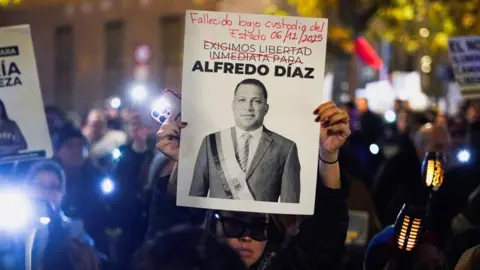
The US has condemned the Venezuelan government over the death of an opposition figure in custody, calling it a 'reminder of the vile nature' of President Nicolás Maduro's regime.
Alfredo Díaz died in his prison cell at the El Helicoide prison in Caracas where he was being held for more than a year, human rights organisations and opposition groups have said.
The Venezuelan government stated that Díaz, 56, showed signs of a heart attack and was taken to the hospital, where he died on Saturday.
The US intervention is the latest escalation in a war of words between the Trump administration and Maduro, who has accused the US of seeking regime change.
In recent months, the US has bolstered its military presence in the region and conducted strikes against alleged drug smuggling vessels. Trump has accused Maduro himself of being the head of a regional drug cartel—an allegation Maduro denies—while threatening potential military action.
The US State Department's Bureau of Western Hemisphere Affairs reported that Díaz had been 'arbitrarily detained' in a 'torture centre'. He was arrested in 2024 after disputing the results of that year's presidential elections, which the government-controlled election council declared in favor of Maduro, despite opposition claims of victory.
Díaz, the former governor of Nueva Esparta, faced accusations of 'incitement to hatred' and 'terrorism' for his political stance. Human rights group Foro Penal voiced concerns about worsening conditions for political prisoners in Venezuela, noting that Díaz had been held in solitary confinement with minimal contact outside.
Alfredo Romero, president of Foro Penal, stated that this latest incident reflects a concerning pattern, as 17 political prisoners have reportedly died since 2014. Prominent opposition figure María Corina Machado, currently evading arrest, lamented Díaz's death as part of a distressing cycle of repression against political dissidents.
The opposition alliance, Democratic Unitary Platform, emphasized that Díaz 'died unjustly'. His party, Democratic Action (AD), also condemned his treatment, highlighting the failure to respect fundamental rights during his imprisonment.
As US and Venezuelan relations grow increasingly strained over issues of drugs and migration, the Venezuelan military has responded by bolstering its ranks amid US military posturing in the region, raising concerns about potential conflict.