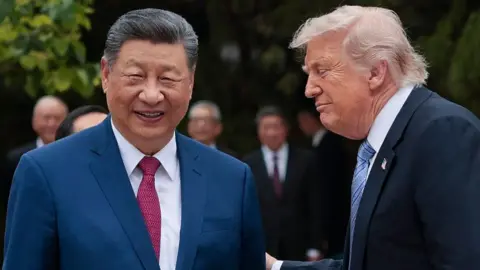
US President Donald Trump left Beijing after a two-day summit saying he had struck 'fantastic trade deals, great for both countries', but few details have emerged on what the two superpowers agreed.
Trump arrived for a high-stakes summit with Chinese leader Xi Jinping, accompanied by a high-profile business delegation spanning agriculture, aviation, and artificial intelligence. Trade was near the top of the agenda despite recent tensions over the Iran war, with businesses hoping for key deals and an extension of the tariff truce set to expire in November.
The visit was characterized by warm rhetoric, with Trump impressed by ceremonial gestures from Xi, who called the talks 'historic and landmark'. However, neither side announced significant trade breakthroughs, raising questions about the future of US-China relations.
Trump mentioned aboard Air Force One that China agreed to buy 200 Boeing jets, potentially leading to the aerospace giant’s first significant deal in China in nearly a decade, yet no confirmation came from China itself. Instead, the foreign ministry advocated for mutual benefit and win-win cooperation.
The two leaders agreed to create a 'Board of Trade' to oversee the relationship, but key topics like tariffs and technology export controls were not at the forefront of their discussions, prompting both criticism and optimism from various sectors.
As they move forward, discussions surrounding Taiwan and geopolitical tensions in the Middle East still remain unresolved, with the upcoming summit in September providing a platform for ongoing negotiations between the two largest economies in the world.