Selling children to survive: Afghan fathers forced to make impossible choices
As dawn breaks, hundreds of men gather at a dusty square in Chaghcharan, the capital of Ghor province in Afghanistan. They line the roadside with weary faces, hoping someone will come along offering any work. It will determine whether their families eat that day. The likelihood of success, however, is low.
Juma Khan, 45, has found just three days of work in the past six weeks that paid between 150 to 200 Afghani ($2.35-$3.13; £1.76-£2.34) per day. My children went to bed hungry three nights in a row. My wife was crying, so were my children. So I begged a neighbour for some money to buy flour, he says. I live in fear that my children will die of hunger. His story is in no way unique.
According to the United Nations, a staggering three in four people in Afghanistan cannot meet their basic needs. Unemployment is rife, healthcare struggling, and the aid that once provided the basics for millions has dwindled to a fraction of what it once was.
The country now faces record levels of hunger, with 4.7 million — more than a tenth of Afghanistan's population — estimated to be one step away from famine. Ghor is one of the worst-affected provinces, and the men here are desperate.
“I got a call saying my children hadn't eaten for two days,” says Rabani, his voice choking. “I felt like I should kill myself. But then I thought how will that help my family? So here I am looking for work.”
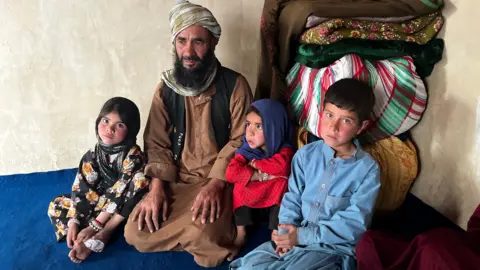
For Abdul Rashid Azimi, the pain of hunger has led to an unimaginable decision. I'm willing to sell my daughters, he weeps. I'm poor, in debt, and helpless. Abdul is concerned for his children, particularly the seven-year-old twins Roqia and Rohila, as he contemplates selling one of them to gather enough resources to feed the rest.
This heartbreaking choice reflects a broader trend where the financial desperation pushes families into deeply troubling territory. Selling children has become a means of survival for many fathers, with Abdul noting that selling one daughter could feed his other children for years.
Equally, Saeed Ahmad knows this pain too intimately. After being forced to sell his five-year-old daughter, Shaiqa, to cover medical expenses, he confirms that selling children is increasingly seen as a harsh yet necessary option.
The Taliban restrictions on education and work for women and girls exacerbate the situation, confining many families to cultural norms that prioritize the sale of daughters over sons. The emotional toll on these fathers is unimaginable as they grapple with their limited choices amid an overwhelming crisis.
Today's conditions in Afghanistan are a stark reminder of the human cost of political and economic strife, reflecting a reality where families are forced into impossible decisions for the sake of survival.