Surviving Sudan: Harrowing Accounts from Those Who Fled the Conflict
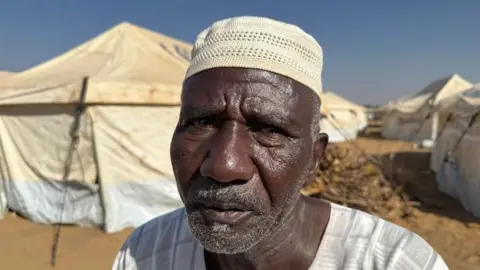
Abdulqadir Abdullah Ali suffered serious nerve damage to his leg during the long siege of the Sudanese city of el-Fasher because he could not get medicine for his diabetes.
The 62-year-old walks with a heavy limp, but when the paramilitary Rapid Support Forces (RSF) captured the city, panic propelled him into action.
“The morning the RSF came there were bullets, many bullets, and explosives going off,” he recalls.
Amid the chaos and fear, families were torn apart as they fled in different directions. The fall of el-Fasher following an 18-month siege represents a brutal chapter in Sudan's ongoing civil war.
The BBC visited a tent camp in northern Sudan to hear firsthand the chilling stories of those who escaped. In April 2023, the RSF began fighting the regular army; their recent victory in el-Fasher has drawn international condemnation for possible mass atrocities.
Ali explains, “They were shooting at the people – the elderly, the civilians, with live ammunition. They would empty their guns on them.”
In the camp, many struggle with the trauma and loss from their harrowing journeys. Reports of violence and rape by RSF fighters have surfaced, compounding the horror experienced by fleeing residents.
Survivors like Mohammed Abbaker Adam describe seeing the dead left unburied on the roadside, recounting, “We saw dead bodies out in the open, some had lain there for two or three days.”
The UN estimates that less than half of the 260,000 people from el-Fasher have been accounted for, raising concerns about those who remain unaccounted due to danger or detention.
Many individuals recount the trauma of checkpoints, where RSF fighters would separate men from women. Abdullah Adam Mohamed, a displaced father, watched as the RSF rounded up men, worried he might never see his young daughters again.
Despite the dire circumstances, resilience shines through. As survivors strive to establish some semblance of safety, their uncertainty about what lies ahead remains palpable. Many have been stripped of their belongings and forced to navigate the treacherous landscape of a war-torn country.