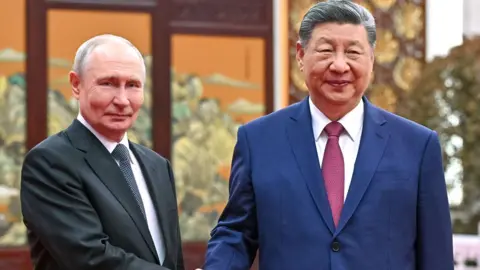
The welcome was distinctly Russian. As Vladimir Putin and Xi Jinping walked the red carpet toward Beijing's Great Hall of the People, a Chinese military band played the romantic Russian classic 'Moscow Nights'—a song with lyrics that seemed to echo the leaders' public embrace. 'My dear friend,' Putin said to Xi, as their hands clasped in a gesture of camaraderie. 'My old friend,' Xi replied, their meeting emblematic of the more than 40 times they've convened over the years. The stage was set for a showcase of strategic partnership: 'mutual respect,' 'trust,' and 'partnership' became buzzwords in their joint statements as they condemned U.S. nuclear policies and Donald Trump's 'Golden Dome' missile defense shield. The Russian government newspaper even contrasted Trump's 'lonely-looking' departure from China with historic photos of Putin and Xi side-by-side, projecting an unmistakable message of Russia-China solidarity.
But this was not a love story. As Putin and Xi exchanged tea in ceremonial settings, the reality of geopolitics emerged. Russia pressed Beijing for a final agreement on Power of Siberia 2, a pipeline meant to deliver Siberian gas to China via Mongolia and compensate for lost European markets. Despite signing a memorandum of understanding last year, China's hesitation was evident. Analysts point to China's desire to avoid over-reliance on Russian energy, compounded by pricing disagreements. The Kremlin announced a 'general understanding on the parameters' but offered no concrete deal. 'The positions of Russia and China are not identical. Their interests do not always coincide,' admitted the Russian newspaper—the same publication that featured Putin-Xi images on its front page.
The summit's contrast with the Russia-U.S. relationship became stark. Following their Alaska meeting in 2023, Russian officials touted the 'spirit of Anchorage' as a path toward ending Ukraine war. Yet Putin's foreign policy aide Yuri Ushakov later confirmed the 'spirit of Beijing exists' but declared 'the spirit of Anchorage? I never used that phrase.' The war in Ukraine, with no resolution, had erased that hopeful framework. The Russian-Chinese alliance may be a cornerstone of multipolarity, but it remains a pragmatic one, built on mutual interests rather than romance or bromance. As Putin left Beijing, the pipeline deal lingered unresolved—proof that even in a friendship, self-interest always shapes the final outcome.}
But this was not a love story. As Putin and Xi exchanged tea in ceremonial settings, the reality of geopolitics emerged. Russia pressed Beijing for a final agreement on Power of Siberia 2, a pipeline meant to deliver Siberian gas to China via Mongolia and compensate for lost European markets. Despite signing a memorandum of understanding last year, China's hesitation was evident. Analysts point to China's desire to avoid over-reliance on Russian energy, compounded by pricing disagreements. The Kremlin announced a 'general understanding on the parameters' but offered no concrete deal. 'The positions of Russia and China are not identical. Their interests do not always coincide,' admitted the Russian newspaper—the same publication that featured Putin-Xi images on its front page.
The summit's contrast with the Russia-U.S. relationship became stark. Following their Alaska meeting in 2023, Russian officials touted the 'spirit of Anchorage' as a path toward ending Ukraine war. Yet Putin's foreign policy aide Yuri Ushakov later confirmed the 'spirit of Beijing exists' but declared 'the spirit of Anchorage? I never used that phrase.' The war in Ukraine, with no resolution, had erased that hopeful framework. The Russian-Chinese alliance may be a cornerstone of multipolarity, but it remains a pragmatic one, built on mutual interests rather than romance or bromance. As Putin left Beijing, the pipeline deal lingered unresolved—proof that even in a friendship, self-interest always shapes the final outcome.}