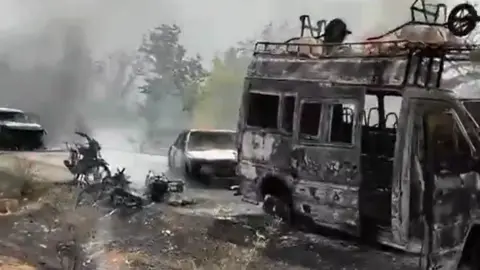
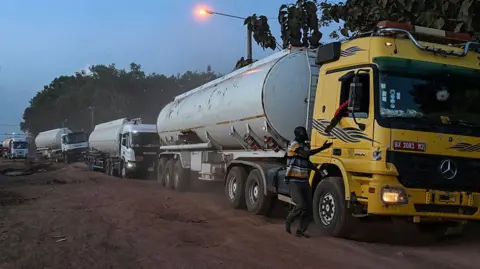
Jihadist fighters in Mali have burned dozens of vehicles—including fuel tankers, minibuses, and trucks—on highways leading to Bamako, intensifying a blockade that threatens to cripple the capital ahead of the Eid al-Adha holiday. The BBC has confirmed through verified video footage that militants set fires to vehicles on a road 45km west of the capital, where charred remains are visible. Witnesses reported drivers were ordered to exit vehicles before they were torched, with no reported casualties.
Jama'at Nusrat al-Islam wal-Muslimin (JNIM), an al-Qaeda affiliate, imposed this fuel blockade last year and has tightened it following attacks on Bamako in April. The group has burned over 100 fuel trucks since last year, kidnapping drivers and sabotaging supply chains to suffocate Mali's economy—a strategy analysts say targets the military junta's legitimacy. The blockade is now causing severe shortages of essentials, with prices soaring: a kilo of potatoes now costs 500 CFA francs ($0.90), up from 350 francs ($0.62), and Eid slaughter animals remain scarce as militants allegedly seize livestock en route to Bamako.
The BBC verified the attack using dual confirmation: matching two distinctive buildings from satellite imagery to video footage, and detecting a heat signature at the location via NASA's Firms platform. The junta, led by Gen. Assimi Goïta, has invited Russian paramilitary group Africa Corp (a Wagner successor) to escort supply convoys, but attacks persist. In January, Gen. Goïta appointed Brigadier Gen. Famouké Camara to lead counter-blockade operations, though effectiveness remains limited.
Residents describe desperation as Eid approaches. 'Travelling would put your life at risk,' says resident Moussa, who has decided to stay in Bamako instead of returning to his village. The blockade has also disrupted traditional Eid practices, with sheep markets in the capital shrinking due to transport restrictions. Meanwhile, analysts warn the crisis reflects deeper governance failures as Mali's military government struggles to control regions where 90% of the population faces insecurity, despite Russian military aid.
This development adds pressure to Gen. Goïta's leadership, which seized power in 2020 promising to restore security but has faced repeated rebel offensives. Last month, coordinated attacks by ethnic Tuareg separatists and JNIM killed Defense Minister Sadio Camara in a suicide bombing near Bamako—a stark reminder of the escalating violence threatening Mali's stability. As Eid looms, the blockade remains a brutal weapon of economic coercion with humanitarian consequences, while real-time updates continue to emerge from the Sahel region.}
Jama'at Nusrat al-Islam wal-Muslimin (JNIM), an al-Qaeda affiliate, imposed this fuel blockade last year and has tightened it following attacks on Bamako in April. The group has burned over 100 fuel trucks since last year, kidnapping drivers and sabotaging supply chains to suffocate Mali's economy—a strategy analysts say targets the military junta's legitimacy. The blockade is now causing severe shortages of essentials, with prices soaring: a kilo of potatoes now costs 500 CFA francs ($0.90), up from 350 francs ($0.62), and Eid slaughter animals remain scarce as militants allegedly seize livestock en route to Bamako.
The BBC verified the attack using dual confirmation: matching two distinctive buildings from satellite imagery to video footage, and detecting a heat signature at the location via NASA's Firms platform. The junta, led by Gen. Assimi Goïta, has invited Russian paramilitary group Africa Corp (a Wagner successor) to escort supply convoys, but attacks persist. In January, Gen. Goïta appointed Brigadier Gen. Famouké Camara to lead counter-blockade operations, though effectiveness remains limited.
Residents describe desperation as Eid approaches. 'Travelling would put your life at risk,' says resident Moussa, who has decided to stay in Bamako instead of returning to his village. The blockade has also disrupted traditional Eid practices, with sheep markets in the capital shrinking due to transport restrictions. Meanwhile, analysts warn the crisis reflects deeper governance failures as Mali's military government struggles to control regions where 90% of the population faces insecurity, despite Russian military aid.
This development adds pressure to Gen. Goïta's leadership, which seized power in 2020 promising to restore security but has faced repeated rebel offensives. Last month, coordinated attacks by ethnic Tuareg separatists and JNIM killed Defense Minister Sadio Camara in a suicide bombing near Bamako—a stark reminder of the escalating violence threatening Mali's stability. As Eid looms, the blockade remains a brutal weapon of economic coercion with humanitarian consequences, while real-time updates continue to emerge from the Sahel region.}