In brief
France is emerging as a potential frontrunner in the quantum computing race, with companies like Alice & Bob leading innovation. This development comes amid a growing global competition, particularly from the US and Finland. The start-up is developing advanced quantum technology, with a focus on overcoming the fragility of qubits to unlock more efficient computations. With a strategic investment in education and resources, Europe hopes to build a competitive edge in this transformative sector.
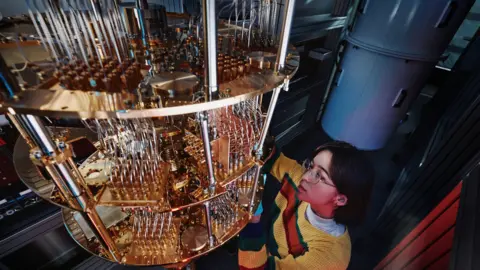
In a lab on the western edge of Paris, where the River Seine flows wide and trams slide past glass-fronted buildings and blossoming cherry trees, a technician called Rémi makes adjustments to a cryostat, a device that cools to minus 273 degrees Celsius, isolating its contents from the outside world.
This device is crucial for quantum computing, housing chips within which quantum leaps occur—phenomena that defy conventional physics. Among these innovators is Alice & Bob, a French quantum computing company gearing up to open a new facility worth $50 million, to further their research and development.
Co-founder and CEO Théau Peronnin emphasizes that unlike classical computers, quantum computers exploit the bizarre behaviors of particles at the quantum level, enabling solutions to problems deemed unsolvable by traditional means. The goal is to revolutionize sectors like medicine by modeling molecular interactions with unprecedented accuracy, making the development of treatments more efficient.
Current competitors include large tech players like Google, while smaller firms like Finland's IQM and the UK’s Oxford Quantum Circuits are also challenging for stakes in quantum technology. France is positioning itself with several capable companies in the sector, underlining a national push to develop a grand-scale quantum computer.
The advanced work done in the country places it on the brink of significant technological advancement. Peronnin optimistically suggests that the continent could emerge as a true leader in the field, provided its innovators believe in their capabilities and harness the collective resources available. The emphasis is not just on catching up but on potential leadership as Europe strives for technological independence and economic competitiveness in this new frontier.