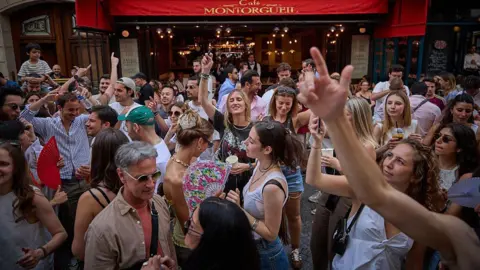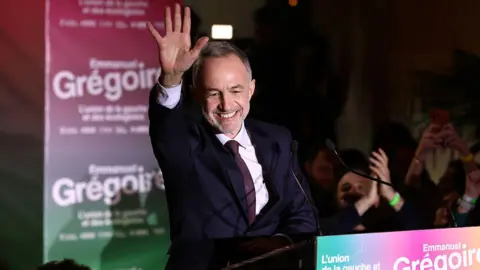
Socialists and allies held on to power in France's big four cities - Paris, Marseille, Lyon and Lille - on a local election night that offered hopes for mainstream parties in next year's presidential elections.
The new aspirants of the far-left and far-right also made gains – notably in Nice for an ally of Marine Le Pen and Roubaix in the north for the France Unbowed (LFI) party.
But the big lesson of the evening was the failure of alliances between mainstream left and LFI, with voters turning to the centre and right in long-time Socialist Party (PS) strongholds like Clermont-Ferrand and Brest. On the contrary, in cities like Paris, Marseille and Lille – where incumbent Socialists steered clear of the far-left because of accusations of sectarian anti-Semitism in its ranks – left-wing administrations were comfortably returned.
Lyon – where the ecologist mayor Gregory Doucet did ally himself with LFI and still won – was seen as a case apart, because the right-wing challenger, businessman Jean-Michel Aulas, ran a poor campaign.
My conclusion from tonight is that the LFI wins nothing – and what is worse it is the LFI that brings about defeat, said Pierre Jouvet, PS secretary-general.
There had been calls for a boycott of LFI after one of its parliamentary assistants was charged with incitement to murdering a far-right student in Lyon. The party's firebrand leader Jean-Luc Mélenchon also enraged his enemies when in a speech he seemed to joke about the Jewishness of the late sex-offender Jeffrey Epstein.
But after round one of voting a week ago, many Socialist and Green candidates decided to overlook their objections to the far-left party and formed what the right then termed alliances of shame in order – they hoped – to secure victory.
Grégoire's win in Paris was in line with opinion polls and confirmed the capital's reputation as a mainly left-wing city. His predecessor Anne Hidalgo had made her mark with vigorously anti-car policies which were in general supported by voters.
Meanwhile, the far-right National Rally (RN) – by far the most popular party in pre-presidential opinion polls – failed to win its targets in Marseille and Toulon, after its opponents rallied against it. In Marseille the Republicans (LR) candidate stayed in the race and split the right-wing vote.
But in Nice Eric Ciotti, leader of the UDR party, won a clear victory over the incumbent Christian Estrosi, a former LR member who defected to the Macronite centre. This was hailed by the RN as a sign of an emerging new right, no longer held back by any taboo about working with Le Pen.
The RN also showed its strength in small provincial towns, with victories in Montargis, Carcassonne and La Seyne-sur-Mer, though it lost the mayoralty of Villers-Cotterets north of Paris.
The elections have confirmed the growing strength of the far-left in the peripheries of big cities, while the far-right RN has established its presence in provincial France. In the end, it was the mainstream parties that scored by far the most victories, giving them reason to hope that in any presidential run-off against a candidate of the extremes, the mainstream will win.
The big worry is: what if - in a presidential run-off - there are two candidates of the extremes?