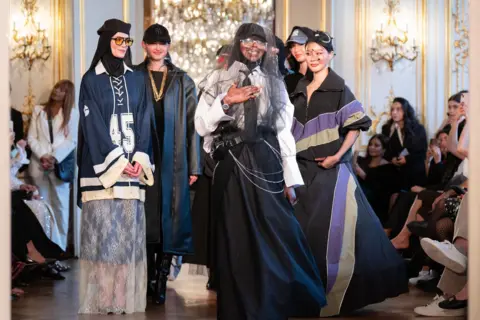
Paris has made headlines by holding its first ever Modest Fashion Week, providing a platform for nearly 30 designers whose collections feature loose, long-cut garments and headscarves. This event carries a significant weight in a country where hijabs and other religious clothing have frequently sparked controversy and have been restricted in many settings.
Rukaiya Kamba, creative director at Flaunt Archive from Nigeria, said that presenting her collection in Paris came from a very intentional place, reflecting a desire for inclusivity and representation. As designers showcased their collections, young attendees expressed their hope that such events would help foster a more inclusive culture in France.
Özlem Şahin, head of the organization behind Modest Fashion Week, labeled Paris as one of Europe’s leading modest fashion capitals, further emphasizing the relevance of such an event in a city with a significant Muslim population estimated at 5-7.5 million. Indeed, it is a vital statement for Muslim women, as Fatou Doucouré, founder of Soutoura, expressed her pride in exhibiting her designs in Paris, highlighting how it represents a shift toward acceptance.
Inside the luxurious Hôtel Le Marois, the focus of the designs showcased was on floral and nature-inspired hues, with a blend from various cultures. Designers like Hicran Önal and Aisa Hassan contributed collections reflecting their respective cultural backgrounds while embracing modern aesthetics.
While the fashion industry initially served Muslim women, it has increasingly attracted a broader audience including other religious communities and secular buyers, indicating a significant cultural shift. Overall, Paris Modest Fashion Week highlighted a growing market trend aimed at modest fashion, projecting over $400 billion in consumer spending worldwide by next year.
Rukaiya Kamba, creative director at Flaunt Archive from Nigeria, said that presenting her collection in Paris came from a very intentional place, reflecting a desire for inclusivity and representation. As designers showcased their collections, young attendees expressed their hope that such events would help foster a more inclusive culture in France.
Özlem Şahin, head of the organization behind Modest Fashion Week, labeled Paris as one of Europe’s leading modest fashion capitals, further emphasizing the relevance of such an event in a city with a significant Muslim population estimated at 5-7.5 million. Indeed, it is a vital statement for Muslim women, as Fatou Doucouré, founder of Soutoura, expressed her pride in exhibiting her designs in Paris, highlighting how it represents a shift toward acceptance.
Inside the luxurious Hôtel Le Marois, the focus of the designs showcased was on floral and nature-inspired hues, with a blend from various cultures. Designers like Hicran Önal and Aisa Hassan contributed collections reflecting their respective cultural backgrounds while embracing modern aesthetics.
While the fashion industry initially served Muslim women, it has increasingly attracted a broader audience including other religious communities and secular buyers, indicating a significant cultural shift. Overall, Paris Modest Fashion Week highlighted a growing market trend aimed at modest fashion, projecting over $400 billion in consumer spending worldwide by next year.