WASHINGTON — The U.S. economy in 2025 presented an extraordinary contrast: while economic growth flourished, job creation stagnated significantly, and inflation persisted, compounding challenges that policymakers must navigate into 2026.
Last year's prominent anomalies sparked critical questions for the future: Will the burgeoning economy eventually catalyze a rejuvenation of the lethargic job market, or do the recent meager job additions signify a looming economic downturn?
A potent concern is that the economy might continue its upward trajectory without corresponding job gains, driven by advanced technologies such as artificial intelligence. This scenario could spawn an unsettling phenomenon termed a jobless expansion, where businesses maximize production with fewer employees.
The government shutdown of late 2024 further exacerbated uncertainty, disrupting the compilation of crucial economic indicators and leaving economists with a murky view of the economic terrain as they head into 2025.
It's challenging to assess how 2025 concluded as we enter this new year, remarked Stephen Stanley, chief economist at Santander, addressing clients recently.
The stark wealth inequality has compounded these challenges, with affluent households accounting for an increasing portion of overall spending. This trend casts doubt over the stability of growth figures and raises concerns regarding the realities faced by lower-income families, crystallizing what many economists describe as a K-shaped economy.
Despite these complexities, there exists cautious optimism. Experts, including Federal Reserve governor Christopher Waller, anticipate improved hiring trends driven by substantial tax refunds linked to income tax reforms and diminished tariff-related uncertainty.
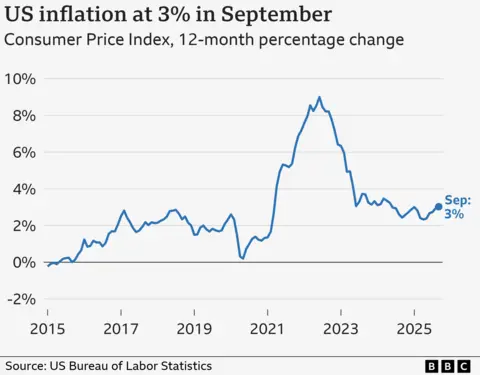
Analysts further highlighted that while inflation had fallen dramatically in previous years, it remained stubbornly high in 2025, leading to significant political consequences that could affect races across the political landscape. Economists now ponder the potential for inflation to escalate again moving into 2026.
As the U.S. approaches a new economic era, marked by these contradictions, the pathway of economic recovery and labor market revival remains one to watch closely.