In brief
Former Apollo astronaut Harrison Schmitt discusses his moon landing experience in 1972, the Artemis II mission, and the potential for establishing a lunar base. He emphasizes the significance of lunar resources like helium-3 for future energy solutions and reflects on the cosmic questions regarding extraterrestrial life.
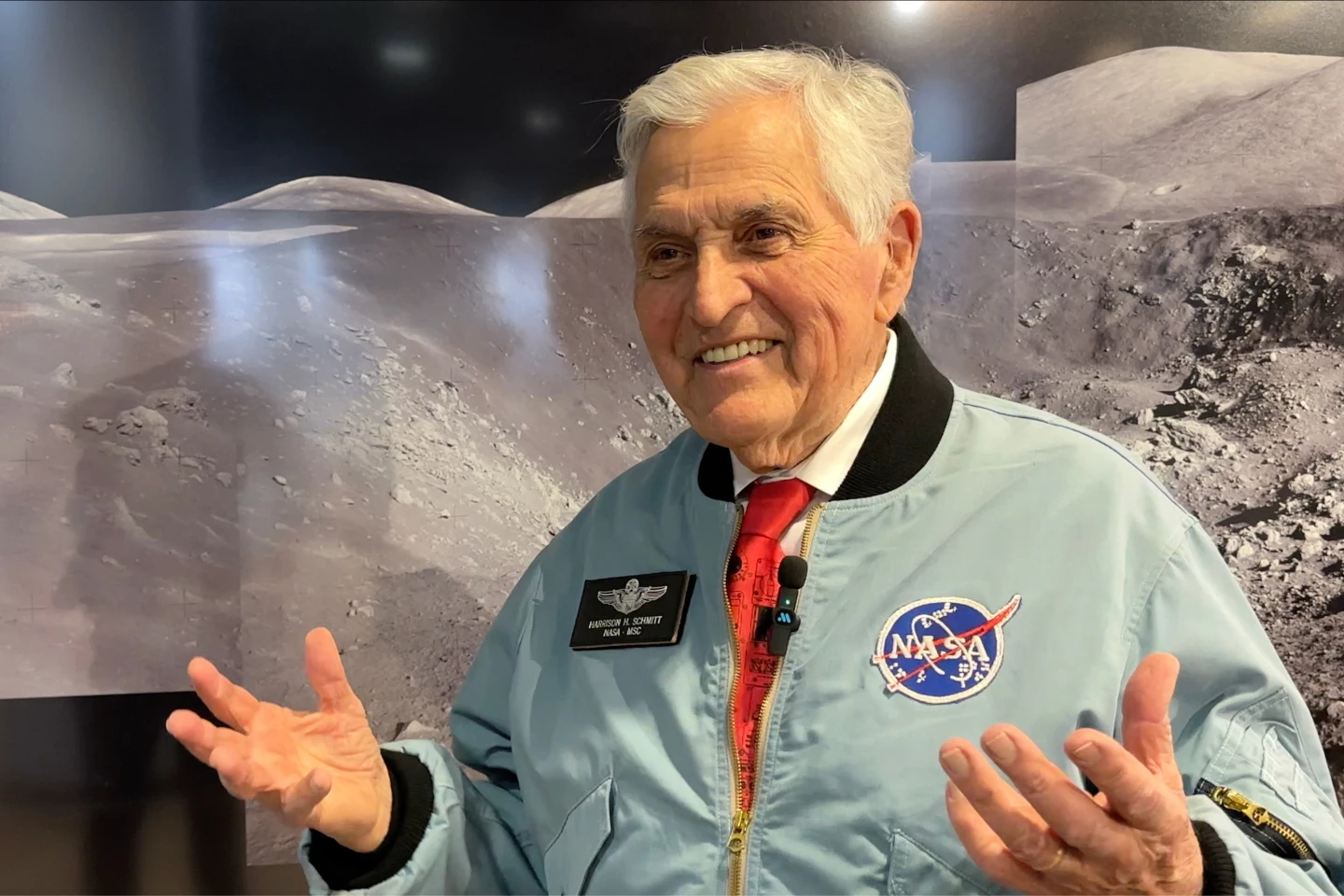
ALBUQUERQUE, N.M. — Harrison “Jack” Schmitt, one of the last surviving Apollo moonwalkers, reflects on the historic Apollo 17 mission and the recent Artemis II flight. Schmitt, a geologist and former U.S. senator from New Mexico, was the first scientist to walk on the moon and is a strong proponent of lunar exploration. During a recent interview, Schmitt recalled stepping onto the lunar surface and collecting samples alongside astronaut Eugene Cernan. Well, I tell you Gene, I think the next generation ought to accept this as a challenge. Let’s see them leave footsteps like these someday,” he said. Now aged 90, Schmitt feels renewed excitement for space exploration as Artemis II embarks on its mission. He is hopeful about the future, stating, “New generations are getting back to the moon and beyond.” He discussed various topics, from establishing a lunar base to energy resources and the potential for life on other planets. On the need for a lunar base, he said, It makes a lot of sense for geopolitical reasons and preparation for Mars missions.” He elaborated on how the moon’s resources could facilitate deeper space travel and the importance of gaining practical experience in deep space environments. Reflecting on the significance of the moon, he emphasized its geological history as a record of the solar system’s evolution. The moon has been recording the history of the solar system for about 4.5 billion years,” he added. Schmitt also highlighted the importance of lunar resources, particularly helium-3, which could revolutionize energy production. Helium-3 offers a possibility of having nuclear energy without nuclear waste,” he explained. This burgeoning interest in lunar resources reflects a new space race, primarily involving China and the U.S. His memories from the Taurus-Littrow Valley underscore the unique challenges and joys of working on the moon. It was like being a kid again, walking in one-sixth gravity,” he recalled. Schmitt believes long-term habitation on the moon is feasible, but challenges such as radiation exposure need to be addressed. As the conversation shifted to extraterrestrial life, Schmitt acknowledged the vast possibilities within the universe. There are billions of sunlike stars out there, which statistically increases the chance of life elsewhere,” he stated. Schmitt remains open to returning to the moon or even to Mars, noting the importance of inspiring youth for future exploration. Youth is extremely important; the education of those youth particularly in mathematics is extraordinarily important,” he concluded, reflecting on the evolution of space exploration since his time. With NASA now integrating commercial technologies into deep space play, he remains optimistic about humanity’s future endeavors beyond Earth.