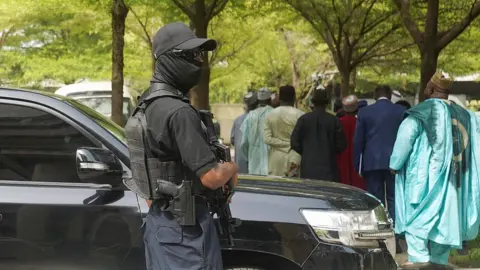
For months rumors and secrecy have surrounded last year's alleged Independence Day coup plot in Nigeria - but with this week's indictment of six people accused of involvement comes the first details of what is said to have been an elaborate plan to oust President Bola Tinubu. It was due to take place on 1 October 2025 - the day Nigeria marked the 65th anniversary of its independence from the UK. But at the very last minute the celebratory parade, to be attended by the president, was cancelled - and the government and military were tight-lipped about why. It was only in January that the military announced, in a statement short on detail, that 16 unnamed senior military officers were to face a court-martial over an alleged plot - effectively admitting a coup attempt had been thwarted.
Now court documents, filed by state prosecutors at the Federal High Court in the capital, Abuja, have revealed the name of the alleged mastermind and suggest that one of the major aims of the plotters was to destabilize the state ahead of the planned takeover.
The six going on trial at the High Court cannot go before a military court - some are civilians, one is a serving police inspector and others are retired military personnel. They have denied the 13 charges, including treason, terrorism, and money laundering - and while they may not necessarily be the ringleaders, their trial is likely to shed light on an alleged plan that is said to have involved all elements of Nigeria's security forces. Nigeria has a long history of military takeovers but has been under civilian rule since 1999. Several other West African countries have experienced coups in recent years and there has been speculation that Nigeria could be next, with economic hardship rising and accusations that the political system was rigged in favor of a small elite.
Court documents point to Colonel Mohammed Ma'aji as the alleged chief strategist behind the coup. Little is known about the 50-year-old, a Muslim born in western Niger state who spent much of his early army career in the southern oil-rich Niger Delta region where he climbed the ranks in the mid-2000s during a time of oil militancy.
Timipre Sylva, contributing as a financier to the alleged coup plot, is also at the center of the investigation. Although not officially indicted, his name appears numerous times in the charges, indicating his potential involvement despite his denial. On the projected day of the coup, the conspirators planned to storm Nigeria's seat of power, Aso Rock presidential villa, and to detain President Tinubu and other officials. Concerns over the plot prompts the military to abandon a planned parade on Independence Day, marking a worrying development in Nigeria's political climate.
Now court documents, filed by state prosecutors at the Federal High Court in the capital, Abuja, have revealed the name of the alleged mastermind and suggest that one of the major aims of the plotters was to destabilize the state ahead of the planned takeover.
The six going on trial at the High Court cannot go before a military court - some are civilians, one is a serving police inspector and others are retired military personnel. They have denied the 13 charges, including treason, terrorism, and money laundering - and while they may not necessarily be the ringleaders, their trial is likely to shed light on an alleged plan that is said to have involved all elements of Nigeria's security forces. Nigeria has a long history of military takeovers but has been under civilian rule since 1999. Several other West African countries have experienced coups in recent years and there has been speculation that Nigeria could be next, with economic hardship rising and accusations that the political system was rigged in favor of a small elite.
Court documents point to Colonel Mohammed Ma'aji as the alleged chief strategist behind the coup. Little is known about the 50-year-old, a Muslim born in western Niger state who spent much of his early army career in the southern oil-rich Niger Delta region where he climbed the ranks in the mid-2000s during a time of oil militancy.
Timipre Sylva, contributing as a financier to the alleged coup plot, is also at the center of the investigation. Although not officially indicted, his name appears numerous times in the charges, indicating his potential involvement despite his denial. On the projected day of the coup, the conspirators planned to storm Nigeria's seat of power, Aso Rock presidential villa, and to detain President Tinubu and other officials. Concerns over the plot prompts the military to abandon a planned parade on Independence Day, marking a worrying development in Nigeria's political climate.