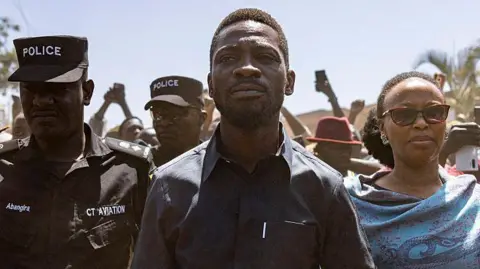
Police in Uganda have denied allegations that presidential candidate Bobi Wine was abducted on Friday evening as vote counting continues in the East African nation amid an internet blackout.
Wine's party said a helicopter landed in the grounds of his house in the capital, Kampala, and forcibly took him to an unknown location.
Initially, Wine's son, Solomon Kampala, stated that both of his parents had been seized, but later claimed that his father 'escaped' and only his mother was being held, leading to confusion over the whereabouts of the opposition leader.
The latest electoral figures from Thursday's vote give President Yoweri Museveni 72% of the vote, with Wine at 24%, based on returns from 94% of polling stations.
Speaking at a press conference on Saturday morning, police spokesman Kituuma Rusoke stated that the National Unity Platform (NUP) party leader was still in his home in Kampala, and that it was Wine's family members who were spreading 'untrue' and 'unfounded' claims.
He explained that Wine's movements were restricted as his home was classified as an area of 'security interest'.
'We have controlled access to areas which are security hotspots,' Uganda's Daily Monitor paper quoted him as saying. 'We cannot allow people to use some places to gather and cause chaos. All our actions are intended to prevent anybody from creating violence or destabilizing our security,' he added.
On Friday, Wine had urged his supporters to disregard the 'fake results' being announced, accusing authorities of 'stealing the vote'. He did not provide any evidence for his claim, and the authorities have not yet responded to his allegations.
Solomon Kampala, who has been providing updates via social media, admitted he was receiving conflicting reports about the security situation at his parents' residence.
'Amidst the raid, my father was able to escape; my mother is still currently under arrest, and no one is allowed to enter the house,' he posted on X on Saturday morning.
Complications with internet access in the country have made it challenging for individuals to confirm information.
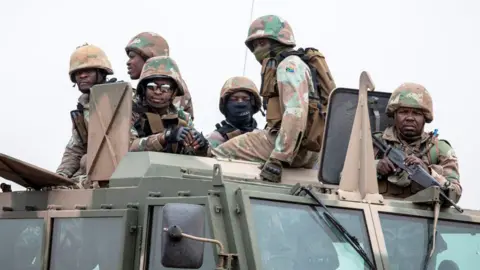
Reports emerged that at least seven opposition supporters were killed under disputed circumstances in Butambala, about 55km (35 miles) south-west of the capital, on Thursday.
The US embassy subsequently issued an alert to its citizens regarding reports that security forces were 'using tear gas and firing into the air to disperse gatherings.'
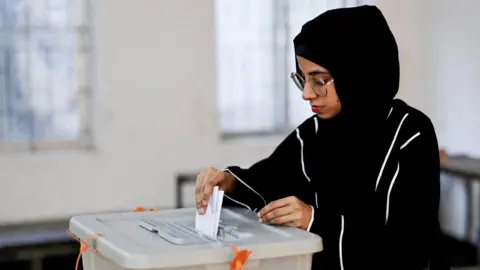
During Thursday's vote, delays occurred at various polling stations as ballot boxes arrived late and biometric machines malfunctioned. Some have linked these issues to the ongoing network outage.
Electoral chief Simon Byabakama stated on Friday that the vote counting had not been disrupted by the internet blackout, and final results would be announced by 17:00 local time (14:00 GMT) on Saturday.
This election follows a tumultuous campaign, with President Museveni, 81, running for a seventh term. He first took power as a rebel leader in 1986.
Bobi Wine, a 43-year-old pop star-turned-politician, has promised sweeping reforms, while Museveni argues that he is the sole guarantor of stability and progress in Uganda.
Although there are six other candidates, the presidential contest is primarily between Museveni and Wine. The campaign was marred by accusations of violence against opposition supporters and the disruption of their activities.
Police spokesman Rusoke dismissed these allegations, asserting that opposition supporters had been the disruptive ones. Internet access was suspended on Tuesday, with the Uganda Communications Commission stating that the blackout was necessary to prevent misinformation, fraud, and incitement of violence, a decision condemned as 'deeply worrying' by the UN human rights office.