For as long as many residents of Nairobi can remember, the Kenyan capital has been awash with red every 14 February. On Valentine's Day, people are dressed in red, the color of love and romance, or are carrying red roses. Traders are quick to cash in, selling fresh blooms from local farms, as Kenya is one of the world's top producers of cut flowers.
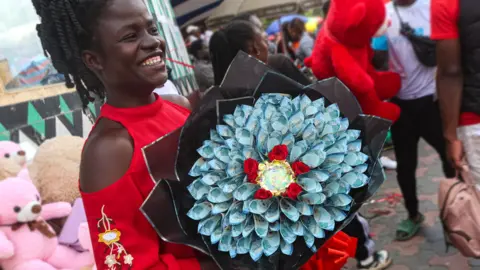
Recently though, instead of the soft red petals, some people have been opting for the brown, blue or purple of crisp banknotes, folded, rolled or fastened together into floral-like bouquets. The trend has spread to other African countries and has become so pervasive that it has drawn the concern of central banks in Kenya, Uganda, Rwanda, Botswana and Namibia.
They have all issued public warnings against damaging or defacing banknotes when making these bouquets of cash. The Central Bank of Kenya (CBK) says that in many instances, banknotes are glued, taped, stapled, pinned or otherwise affixed. Damaged notes can then be rejected by automated teller machines (ATMs) and cash-sorting equipment, meaning they have to be withdrawn from circulation, at a cost to the taxpayer.
In its notice, the CBK said it was not opposed to the use of cash gifts - only to practices that damaged notes - an offense that could lead to creators of money bouquets being jailed for up to seven years.
Cash bouquets have been popularized by celebrities and online influencers, who often share videos of themselves presenting such gifts. The celebrations are not limited to Valentine's Day - they extend to birthdays and other special occasions, meaning money bouquets are in demand throughout the year.
The bouquets come in various designs, with creators arranging the banknotes to suit the taste and budget of each customer. The wads of cash used in such bouquets vary widely - they can amount to as little as 1,000 shillings ($8) or as much as a million shillings, says Angela Muthoni, a florist at the Gift and Flowers shop in central Nairobi.
While many are created in floral designs, or a mix of flowers and money with elegant wrappings, they can also be part of cake designs or be given in gift boxes. Muthoni says money bouquets have become popular in the last two years. In the run-up to Valentine's Day, she has been receiving orders of between 15 and 20 bouquets every day, despite the CBK's warning.
Everyone loves money, she tells the BBC, adding that gifting cash removes the stress of choosing a present. Some Kenyans, however, argue that it just shows that people are becoming more materialistic, seeking to buy love with money, rather than romance. It's some form of peer pressure, says 24-year-old Haskell Austin, who prefers giving flowers, describing the idea of gifting money as materialistic. But if cash must be given, he prefers a straightforward transfer instead of folding or decorating it into bouquets.
The trend has also prompted discussions on social media, with various opinions surfacing regarding the implications of money bouquets and the impact they have on relationships. Economic expert Odhiambo Ramogi states, Capitalistic societies are driven by advertising, by marketing and special days like Valentine's are a very good opportunity.
Despite the CBK's warnings and opinions against the trend, it seems the money bouquet culture is unlikely to diminish. Florists are finding innovative ways to create these bouquets without harming the currency, ensuring that the tradition can continue on its own terms.
Recently though, instead of the soft red petals, some people have been opting for the brown, blue or purple of crisp banknotes, folded, rolled or fastened together into floral-like bouquets. The trend has spread to other African countries and has become so pervasive that it has drawn the concern of central banks in Kenya, Uganda, Rwanda, Botswana and Namibia.
They have all issued public warnings against damaging or defacing banknotes when making these bouquets of cash. The Central Bank of Kenya (CBK) says that in many instances, banknotes are glued, taped, stapled, pinned or otherwise affixed. Damaged notes can then be rejected by automated teller machines (ATMs) and cash-sorting equipment, meaning they have to be withdrawn from circulation, at a cost to the taxpayer.
In its notice, the CBK said it was not opposed to the use of cash gifts - only to practices that damaged notes - an offense that could lead to creators of money bouquets being jailed for up to seven years.
Cash bouquets have been popularized by celebrities and online influencers, who often share videos of themselves presenting such gifts. The celebrations are not limited to Valentine's Day - they extend to birthdays and other special occasions, meaning money bouquets are in demand throughout the year.
The bouquets come in various designs, with creators arranging the banknotes to suit the taste and budget of each customer. The wads of cash used in such bouquets vary widely - they can amount to as little as 1,000 shillings ($8) or as much as a million shillings, says Angela Muthoni, a florist at the Gift and Flowers shop in central Nairobi.
While many are created in floral designs, or a mix of flowers and money with elegant wrappings, they can also be part of cake designs or be given in gift boxes. Muthoni says money bouquets have become popular in the last two years. In the run-up to Valentine's Day, she has been receiving orders of between 15 and 20 bouquets every day, despite the CBK's warning.
Everyone loves money, she tells the BBC, adding that gifting cash removes the stress of choosing a present. Some Kenyans, however, argue that it just shows that people are becoming more materialistic, seeking to buy love with money, rather than romance. It's some form of peer pressure, says 24-year-old Haskell Austin, who prefers giving flowers, describing the idea of gifting money as materialistic. But if cash must be given, he prefers a straightforward transfer instead of folding or decorating it into bouquets.
The trend has also prompted discussions on social media, with various opinions surfacing regarding the implications of money bouquets and the impact they have on relationships. Economic expert Odhiambo Ramogi states, Capitalistic societies are driven by advertising, by marketing and special days like Valentine's are a very good opportunity.
Despite the CBK's warnings and opinions against the trend, it seems the money bouquet culture is unlikely to diminish. Florists are finding innovative ways to create these bouquets without harming the currency, ensuring that the tradition can continue on its own terms.