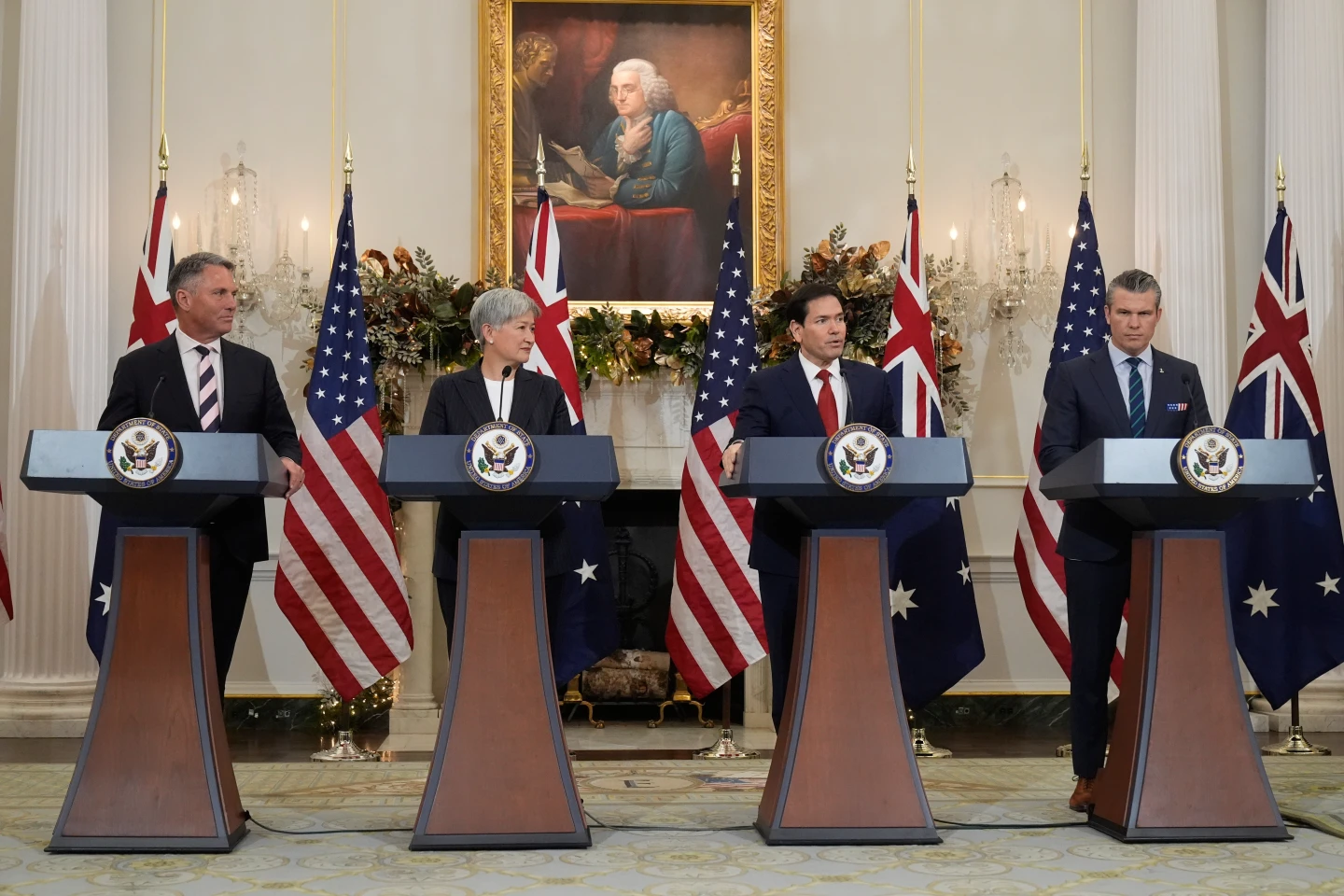
Washington, D.C. — On Monday, U.S. Secretary of State Marco Rubio and Defense Secretary Pete Hegseth hosted Australian Foreign Minister Penny Wong and Defense Minister Richard Marles for their annual discussions centered on Indo-Pacific security. The talks, which come amid growing concerns regarding China's assertiveness in the region, including its activities in the South China Sea and towards Taiwan, also touched on the impacts of the ongoing Russia-Ukraine war and other global conflicts.
Rubio underscored the strength of the U.S.-Australia partnership, advocating for continued cooperation in areas such as critical minerals, defense production, and troop deployments. This is a very strong partnership, it’s a strong alliance, and what we want to do is continue to build on it. We think we have a lot of momentum behind this alliance, he stated.
Although the leaders refrained from naming China directly, it was evident that addressing challenges posed by Beijing is a crucial aspect of their dialogue. The longstanding U.S.-Australia alliance has been vital in navigating the complexities of the Pacific region, particularly in light of China's increasing influence.
Rubio pointed out the need for reliable and diverse critical mineral supply chains, which are essential for various technologies and military capabilities, stressing that dependence on a single supplier could pose a security risk. This perspective aligns with the Biden administration's commitment to the AUKUS pact, which seeks to bolster Australia’s naval capacities through U.S. nuclear technology.
Hegseth echoed his commitment to AUKUS, highlighting Australia's substantial investment in U.S. submarine production capabilities as a mutual benefit to all three countries involved. Both sides reiterated their dedication to ensuring the alliance yields tangible benefits for security and prosperity, as they navigate an increasingly contested geopolitical landscape.
Rubio underscored the strength of the U.S.-Australia partnership, advocating for continued cooperation in areas such as critical minerals, defense production, and troop deployments. This is a very strong partnership, it’s a strong alliance, and what we want to do is continue to build on it. We think we have a lot of momentum behind this alliance, he stated.
Although the leaders refrained from naming China directly, it was evident that addressing challenges posed by Beijing is a crucial aspect of their dialogue. The longstanding U.S.-Australia alliance has been vital in navigating the complexities of the Pacific region, particularly in light of China's increasing influence.
Rubio pointed out the need for reliable and diverse critical mineral supply chains, which are essential for various technologies and military capabilities, stressing that dependence on a single supplier could pose a security risk. This perspective aligns with the Biden administration's commitment to the AUKUS pact, which seeks to bolster Australia’s naval capacities through U.S. nuclear technology.
Hegseth echoed his commitment to AUKUS, highlighting Australia's substantial investment in U.S. submarine production capabilities as a mutual benefit to all three countries involved. Both sides reiterated their dedication to ensuring the alliance yields tangible benefits for security and prosperity, as they navigate an increasingly contested geopolitical landscape.