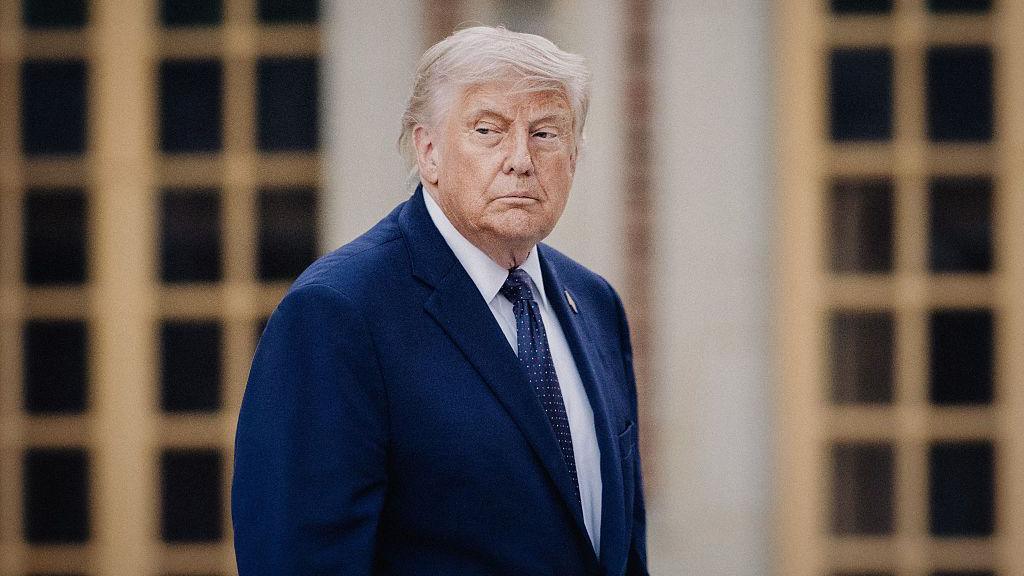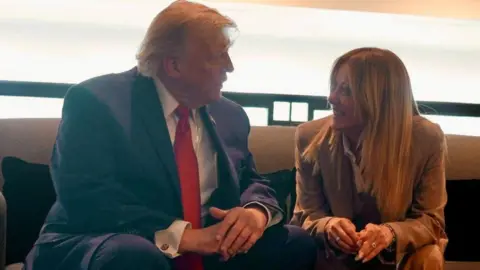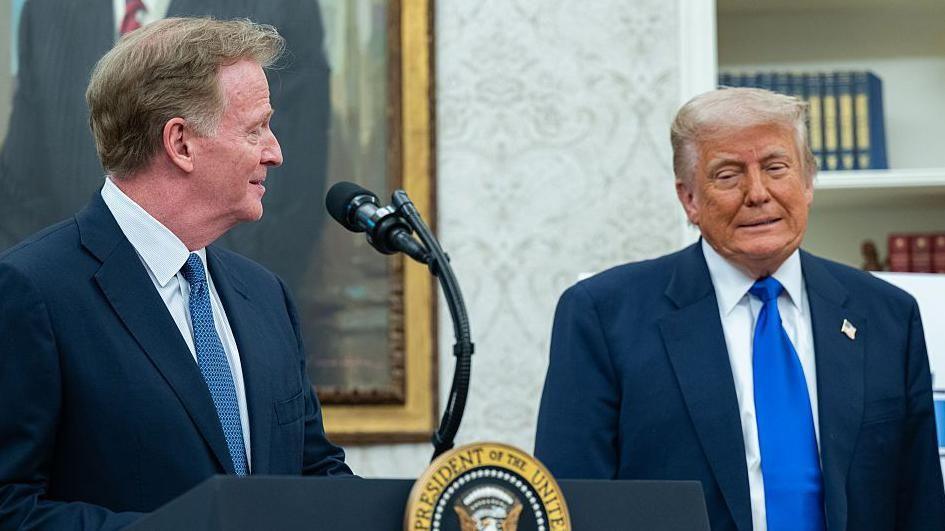
American football fans never thought they would see the day - the head of the National Football League standing shoulder to shoulder with Donald Trump in the Oval Office.
Trump has frequently traded blows with the NFL since he first became US president in 2017, but he and America's most popular sports league have been sparring partners for more than 40 years.
Trump's 'feud' with the NFL has involved him testifying against the league and failing, on multiple occasions, to buy a team. It may even have propelled him to the presidency.
When NFL commissioner Roger Goodell joined Trump in May to announce the NFL Draft would be coming to Washington DC for the first time, it seemed Trump had finally made friends with arguably his oldest foe.
Well, maybe not. With this season set to conclude with Super Bowl 60 on Sunday, BBC Sport examines Trump's long and complicated relationship with the NFL and why it could be set for another twist.
Lawsuit fails to force league merger
Already a real-estate magnate by that point, Trump viewed owning an American football team as a means of building his brand. After attempting to acquire an NFL franchise, a 37-year-old Trump bought the New Jersey Generals in September 1983.
They were founding members of the USFL, which started in the spring of 1983 and did not clash with the NFL. The new league managed to lure top players from the NFL and the college game.
The Generals improved during their two seasons under Trump but lost in the first round of the playoffs in both 1984 and 1985.
However, Trump had made his intentions clear from the outset. He didn't want the USFL to remain a spring league; he wanted to go directly against the NFL in autumn-winter.
That was not the USFL's original plan but, in August 1984, Trump convinced team owners to vote on switching to an autumn-winter schedule from 1986.
Then, two months later, the USFL filed an anti-trust lawsuit against the NFL - led by Trump. The case went to trial in May 1986, with the USFL arguing the NFL had conspired to monopolize TV contracts, seeking damages worth $1.7 billion.
Trump hoped it would force a league merger and earn him an NFL franchise. The trial lasted 42 days, and a jury found the NFL was an 'illegal monopoly'. But it rejected the other charges, resulting in just $3 awarded to the USFL.
In a book about the USFL, one of the jurors said Trump came off as arrogant and unlikeable in court.
Trump's complicated narrative includes multiple media clashes, public criticisms, and political posturing amidst a backdrop of sports culture that continues to intersect with governance.