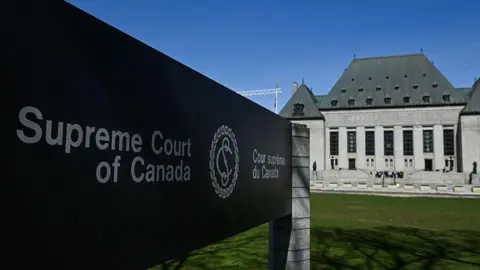
WASHINGTON (AP) — The Supreme Court grappled Tuesday with whether the Trump administration should be able to revive an immigration policy that has been used to turn back migrants seeking asylum at the U.S.-Mexico border.
Some conservative justices seemed receptive to the Justice Department’s push to overturn a lower-court ruling against the practice known as metering. Immigration authorities limited the number of people who could apply for asylum, asserting it was necessary to manage an upsurge at the border.
Critics argue the policy created a humanitarian crisis during President Donald Trump’s first term by forcing many asylum-seekers to wait in makeshift camps in Mexico.
Currently, the policy is not in effect, and Trump had called for a suspension of the asylum system at the start of his second term.
The administration, nonetheless, maintains that metering is a “critical tool” utilized across administrations from both parties, advocating for its availability should the situation necessitate in the future.
While some justices expressed support for this argument, others raised concerns about whether the policy might restrict legitimate asylum-seekers while allowing those who enter the country illegally to apply.
Justice Brett Kavanaugh questioned the rationale behind granting privileges to individuals who unlawfully enter the U.S., while Vivek Suri, assistant to the solicitor general, explained that the current capacity to process applications could change.
Legal experts are divided on the implications of the term “arrive in” as it relates to the asylum law and whether it applies to individuals stopped on the Mexican side of the border.
The Chief Justice, John Roberts, along with Justice Ketanji Brown Jackson, engaged the attorneys on the ambiguity associated with applying the policy while it remains inactive.
Historically, metering was introduced during Obama’s presidency amid a surge of Haitian migrants and was broadly enforced during Trump’s administration. The practice ceased in 2020 due to the pandemic, with President Biden officially rescinding it in 2021. A federal judge's ruling noted that metering infringed upon migrants' constitutional rights, bringing to light the complexities surrounding the issue.
Migrants can apply for asylum once they are on U.S. soil, with requirements that they demonstrate a fear of persecution based on race, religion, nationality, membership in a specific social group, or political opinion. Successful asylum applicants gain significant rights including the ability to work and pathways to citizenship.