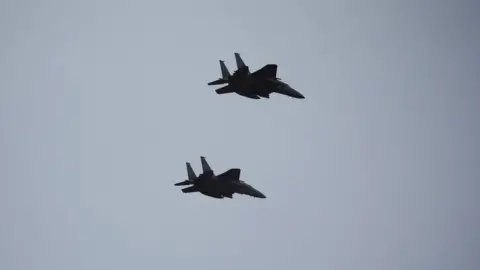
The Israeli military says plans for the expansion of ground and air attacks against the Lebanese armed group Hezbollah have been approved, amid fears in Lebanon that Israel is preparing a large-scale ground invasion of the country.
Israel has intensified its campaign against Hezbollah, an Iranian-backed militia and political party, after the group fired rockets into Israel earlier this month amid the war between the US and Israel against Iran.
Since then, more than 1,000 people have been killed in Lebanon, according to the Lebanese health ministry, including at least 118 children and 40 health workers.
More than a million people have been displaced, which could lead to a major humanitarian crisis.
Israeli officials say the aim is to protect communities in northern Israel from Hezbollah attacks. On Sunday, the Israeli military said the chief of the general staff, Lt Gen Eyal Zamir, had approved plans 'to advance the targeted ground operations and strikes' against Hezbollah, and that this would be a 'prolonged operation.'
This followed a statement by the defence minister, Israel Katz, who said Israeli forces had been instructed to destroy the crossings over the Litani river that were being used by Hezbollah to send reinforcements. An Israeli air strike then damaged the Qasmiye bridge on one of the main routes linking the south to central Lebanon, near the coastal city of Tyre.
Lebanon, many worry, faces plans by Israel to isolate the south – the heartland of the Shia community and of Hezbollah – from the rest of the country ahead of an operation to occupy some areas and create a so-called buffer zone.
Lebanon's President Joseph Aoun stated the Israeli strikes are a 'prelude to a ground invasion,' labeling it a 'policy of collective punishment against civilians,' and suggesting they could be part of 'suspicious schemes' to further expand Israel's territory.
Katz also mentioned that Israeli forces had been ordered to demolish homes in Lebanese border villages to neutralise threats to Israeli communities. He noted the method would mirror that used in the conflict against Hamas in Gaza, where the Israeli military engaged in systematic destruction of buildings to establish security zones.
The ongoing war was sparked by the Hamas-led attack on southern Israel on 7 October 2023, leading to substantial casualties on both sides. The latest escalation began following Hezbollah rocket fire in retaliation for the killing of Iran's supreme leader and ongoing Israeli assaults.
Lebanon's government has committed to disarming Hezbollah, which was formed in the 1980s in response to Israel's occupation during the civil war, but the group has resisted discussions on its weapons.
President Aoun has cautioned against the use of force, warning that it could worsen sectarian divisions.