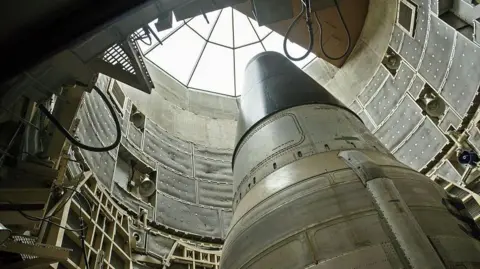
The last nuclear weapons control treaty between the US and Russia is due to expire on Thursday, raising fears of a new arms race. The Strategic Arms Reduction Treaty, known as New START, was signed in 2010 as a measure to mitigate the risk of nuclear conflict. The treaty capped the number of deployed strategic nuclear warheads for each party to 1,550, and facilitated transparency measures through data transfers, notifications, and onsite inspections.
The impending expiration of the treaty effectively ends a significant era of cooperation in arms control, which helped manage nuclear arms post-Cold War. On Wednesday, Pope Leo urged both parties to renew the treaty, emphasizing the urgency to prevent a new arms race given the current global tensions.
The original START treaty, initiated in 1991, restricted each signatory to a maximum of 6,000 nuclear warheads. New START followed in 2010, fostering a cooperative framework between the US and Russia.
Despite a technical suspension of the treaty’s implementation three years ago, both nations appeared to adhere to its core stipulations.
The collapse of this treaty is part of a broader pattern where key arms control agreements have deteriorated. Other notable treaties that have fallen by the wayside include the Intermediate-Range Nuclear Forces Agreement, which eliminated shorter-range nuclear deployments in Europe, and the Open Skies Treaty, which allowed unarmed aerial reconnaissance flights over the territory of each signatory for monitoring purposes.
Former British Armed Forces head Admiral Sir Tony Radakin has expressed concern that the loss of these frameworks poses a significant risk to global security, highlighting the worrying trend of nuclear weapons gaining salience among various nations.
The implications are serious; nations like Russia and the US are currently modernizing their nuclear capabilities, and the development of hypersonic missiles could complicate future arms control negotiations.
While the need for a new treaty is recognized, neither side appears eager to initiate talks. As both countries advance their military technological boundaries, the potential for misjudging intentions remains, raising alarms over the risks of a new arms race.
The impending expiration of the treaty effectively ends a significant era of cooperation in arms control, which helped manage nuclear arms post-Cold War. On Wednesday, Pope Leo urged both parties to renew the treaty, emphasizing the urgency to prevent a new arms race given the current global tensions.
The original START treaty, initiated in 1991, restricted each signatory to a maximum of 6,000 nuclear warheads. New START followed in 2010, fostering a cooperative framework between the US and Russia.
Despite a technical suspension of the treaty’s implementation three years ago, both nations appeared to adhere to its core stipulations.
The collapse of this treaty is part of a broader pattern where key arms control agreements have deteriorated. Other notable treaties that have fallen by the wayside include the Intermediate-Range Nuclear Forces Agreement, which eliminated shorter-range nuclear deployments in Europe, and the Open Skies Treaty, which allowed unarmed aerial reconnaissance flights over the territory of each signatory for monitoring purposes.
Former British Armed Forces head Admiral Sir Tony Radakin has expressed concern that the loss of these frameworks poses a significant risk to global security, highlighting the worrying trend of nuclear weapons gaining salience among various nations.
The implications are serious; nations like Russia and the US are currently modernizing their nuclear capabilities, and the development of hypersonic missiles could complicate future arms control negotiations.
While the need for a new treaty is recognized, neither side appears eager to initiate talks. As both countries advance their military technological boundaries, the potential for misjudging intentions remains, raising alarms over the risks of a new arms race.