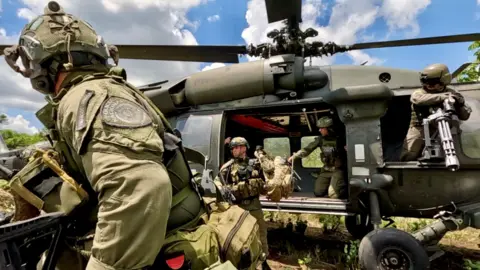
The Black Hawk helicopter was ready for takeoff – its rotor blades slicing through the air in the oppressive heat of the Colombian Amazon. We ducked low and crammed in alongside the Jungle Commandos – a special police unit trained and equipped with support from the United States.
The mission was familiar, the commandos heavily armed, but there was a palpable tension on board. When targeting any aspect of drug trafficking in Colombia, readiness for conflict is paramount.
Taking off, we flew over Putumayo, near the Ecuador border, a region teeming with cocaine production—Colombia accounts for approximately 70% of the global supply. Below us, dense forests revealed telltale patches of bright green, indicators of extensive coca cultivation, suggesting the illicit crop's reach now spans an area almost twice the size of Greater London.
President Donald Trump has criticized Colombia's current administration for not sufficiently curbing cocaine production, while President Gustavo Petro claims his government has seized historic quantities of drugs amidst soaring production rates. As these two leaders prepare to meet at the White House, the dynamics between eradication efforts and economic realities remain contentious.
Our operations culminated in the discovery of a crude cocaine lab in the jungle, representative of the broader drug challenges facing the region. Commandos quickly moved to destroy the facility, aware that many more similar labs might be operational nearby.
Major Cristhian Cedano Díaz shared the reality of their fight: although labs can be rebuilt within a day, they aim to disrupt the profitability of drug cartels consistently. However, he acknowledged that the evolving tactics of these criminal organizations present a formidable challenge.
As we traversed the mountains towards the Colombian Andes, we met local farmers like "Javier," who revealed the desperate economic conditions driving coca cultivation despite the risks involved. His insights starkly contrasted with the military perspective, illustrating the complexities of this endless conflict.
Both Major Cedano Díaz and Javier, representing opposing sides of the war on drugs, express a shared hope that their children will inherit a Colombia transformed beyond the constraints of this perpetual struggle.