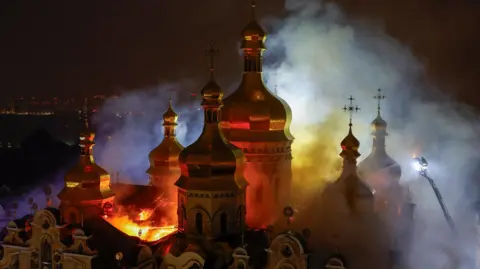
Hong Kong's leader John Lee has ordered the creation of an independent committee to investigate the cause of a devastating fire that killed at least 151 people. Last Wednesday, seven of eight tower blocks at the Wang Fuk Court housing complex - which had been undergoing extensive renovations - went up in flames. Investigators have since found that a protective netting used around the buildings failed to meet flame retardant standards. At least 13 people have been arrested for suspected manslaughter, including the directors of a construction company. The fire is the deadliest the city has seen in more than 70 years, and the death toll could rise further as officials continue to recover bodies.
Chief Executive Lee stated that the committee would be led by a judge and aims to conduct comprehensive reform, emphasizing the need to prevent similar tragedies in the future. He acknowledged existing failures in fire safety protocols but did not directly address why he should retain his position during a news conference. On the day of the incident, the fire spread rapidly due to flammable exterior materials, with blazing flames engulfing the tower blocks before it was finally extinguished by over 2,000 firefighters after approximately 40 hours.
As the investigation commences, police are gathering evidence from the affected buildings. Authorities have also discovered that fire alarms in each of the eight blocks were ineffective. Meanwhile, the buildings department has put a halt to work on 30 private construction projects as a precaution.
Notably, a petition calling for an independent inquiry into the fire quickly gathered over 10,000 signatures before being removed, with reports of police detaining individuals linked to the petition. Amnesty International and Human Rights Watch have denounced the arrests, calling for transparency in the investigation instead of suppression of dissent.
The Wang Fuk Court, built in 1983, housed nearly 4,600 residents, many of whom are elderly. Historical context reveals the gravity of this tragedy—Hong Kong's second-deadliest fire on record occurred in 1948, with the worst being the Happy Valley Racecourse fire in 1918, which claimed more than 600 lives.
Chief Executive Lee stated that the committee would be led by a judge and aims to conduct comprehensive reform, emphasizing the need to prevent similar tragedies in the future. He acknowledged existing failures in fire safety protocols but did not directly address why he should retain his position during a news conference. On the day of the incident, the fire spread rapidly due to flammable exterior materials, with blazing flames engulfing the tower blocks before it was finally extinguished by over 2,000 firefighters after approximately 40 hours.
As the investigation commences, police are gathering evidence from the affected buildings. Authorities have also discovered that fire alarms in each of the eight blocks were ineffective. Meanwhile, the buildings department has put a halt to work on 30 private construction projects as a precaution.
Notably, a petition calling for an independent inquiry into the fire quickly gathered over 10,000 signatures before being removed, with reports of police detaining individuals linked to the petition. Amnesty International and Human Rights Watch have denounced the arrests, calling for transparency in the investigation instead of suppression of dissent.
The Wang Fuk Court, built in 1983, housed nearly 4,600 residents, many of whom are elderly. Historical context reveals the gravity of this tragedy—Hong Kong's second-deadliest fire on record occurred in 1948, with the worst being the Happy Valley Racecourse fire in 1918, which claimed more than 600 lives.