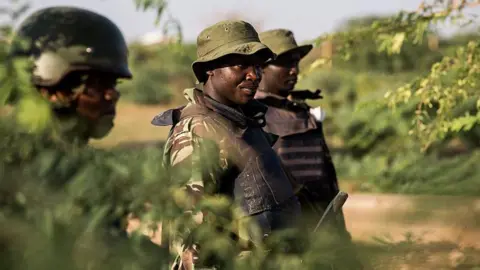
Armed men have kidnapped 28 people travelling to an annual Islamic event in Nigeria's central Plateau state, local police confirmed.
The victims, which include women and children, were ambushed in their bus on Sunday night while traveling between villages.
Police spokesperson Alabo Alfred stated that authorities have deployed assets to the affected area with the aim of rescuing those abducted.
This troubling news arises just a day after Nigerian authorities announced the release of the remaining 130 schoolchildren and teachers from a previous mass kidnapping at a Catholic boarding school in Niger state.
A journalist based in Plateau state reported that families of the latest victims have begun receiving ransom demands.
The police have not disclosed information about the possible perpetrators behind this incident.
Kidnappings for ransom by criminal gangs, locally referred to as bandits, have become prevalent across parts of northern and central Nigeria. Although it is illegal to pay a ransom, it is widely believed that many of these cases are resolved through cash payments, enabling these criminal groups to sustain their activities.
The incident in Plateau state is not connected to the long-standing Islamist insurgency in Nigeria's northeast, where jihadist groups have been engaged in conflict with the state for over a decade.
This wave of insecurity in Nigeria gained renewed international attention recently after US President Donald Trump threatened military intervention, alleging that Christians were specifically targeted.
Nigeria's federal government has acknowledged its security challenges but has denied accusations of targeting Christians.
On Monday, Information Minister Mohammed Idris indicated that recent tensions with the U.S. over security issues had been largely addressed, leading to strengthened relations with Washington. He also announced plans to deploy trained forest guards to secure remote areas utilized by criminal groups, augmenting army operations in the region.
Additional reporting by Abayomi Adisa and BBC Monitoring