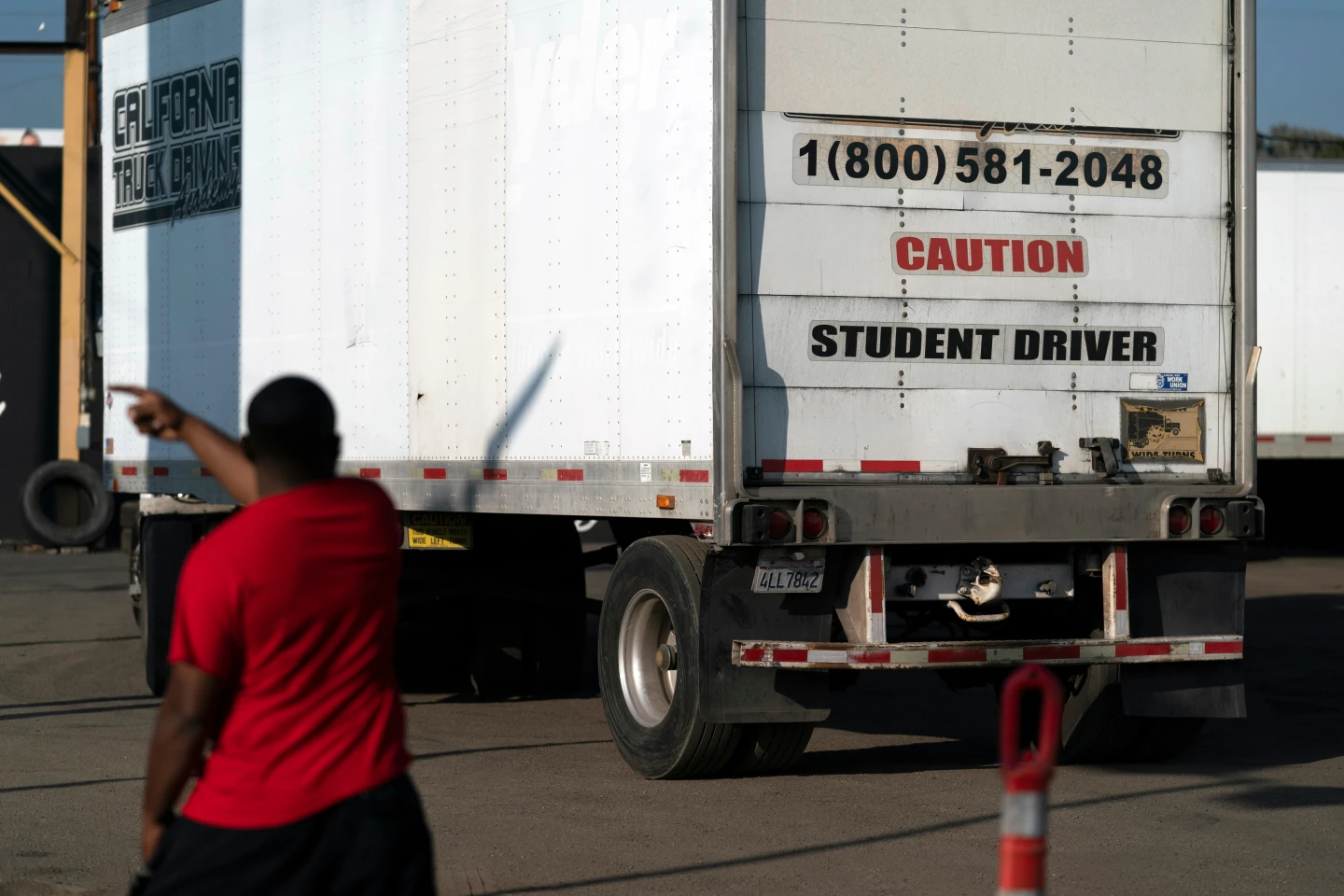
The Trump administration’s latest move to enforce standards for commercial truck drivers, by flagging nearly half of the driving schools as noncompliant, doesn’t figure to disrupt the industry, experts say. But the heavy scrutiny on immigrant drivers might.
The bigger, more reputable schools were not included in the list and many of the schools that were appear to have already been idle, leading trucking industry officials to predict minimal turmoil. The self-certification process that has been in place since 2022 allowed questionable schools to gain recognition. Plus, these efforts to enforce training standards — and the previous moves to strengthen licensing particularly for immigrants — will take effect gradually over time as licenses come up for renewal and new drivers graduate from schools.
The fact that there are probably more drivers than needed right now in the midst of a 10% drop in shipments since 2022 because of the economic uncertainty also helps, although trucking companies still struggle to find enough well-qualified drivers with clean records.
Even before a truck driver that Transportation Secretary Sean Duffy says was not authorized to be in the U.S. made an illegal U-turn and caused a crash in Florida that killed three people, the administration focused on making sure truck drivers meet English proficiency standards. The focus on immigrant drivers intensified after that August crash as the Transportation Department audited commercial driver’s license programs and Duffy proposed new restrictions that would severely limit which noncitizens could get a license to drive a semi or a bus.
A court put the new rules on hold, but Duffy threatened to withhold millions from California, Pennsylvania and Minnesota after audits found significant problems under the existing rules like commercial licenses being valid long after an immigrant truck driver’s work permit expired. That pressure prompted California to revoke 17,000 licenses.
Some immigrant drivers are afraid to go on the road
Trucking company owner Dave Atwal said that as a result many of his drivers at Diamond Transportation in Lodi, California, are “just afraid to go to some of these other states where they might get harassed.” Atwal has been able to assign some drivers to in-state routes, but he has lost more than 40 drivers who either walked away from the job or were unable to renew their licenses even though they have several years of safe driving on their records.
Dave Laut said he has had a hard time finding all the drivers he wants for his approximately 300 trucks at FBT Inc. Immigrant drivers are bearing the brunt of government enforcement, according to Laut, who is Sikh like the driver in the Florida crash and the driver of another fatal crash in California this fall.
“A lot of (Sikhs) are quitting truck driving,” he said. “They feel people target them, and they feel insulted, and they are quitting jobs. They are hardworking guys. They stand out more.”
Laut said his company underwent a Homeland Security audit of his drivers’ immigration statuses about two weeks ago. It passed that review, which many trucking firms in California are undergoing.
But Duffy’s announcement Monday that as many as 7,500 trucking programs could soon be decertified will threaten the ongoing effort to attract and train new drivers — particularly if any schools doing things the right way get caught up with schools not playing by the rules. But many of the schools that would be forced out of business were already idle before the Transportation Department took action, so decertifying them may not have a dramatic impact. The majority of the schools at risk either failed to submit a required biannual report or hadn’t submitted any certificates verifying that a student completed their course in the past year.
Trucking industry can likely absorb the changes
Logan Cooper, who arranges for trucks to deliver containers of imported goods from ports and rail yards for OEC Group, noted, “there’s some room to absorb this in the industry,” but there will likely be some impact over time. But Blair Robbins, who advises companies about their transportation needs as a partner with EisnerAmper, said that even if these efforts lead to higher rates, they would be off the current lower shipping rates, which are depressed due to a decline in shipments in recent years. Robbins estimates that only about 5% to 10% of the workforce might be affected, and that will happen gradually over time.
Tougher standards should mean safer drivers
Dane Rogers, CEO of Western Pacific Truck School in California and the national Commercial Vehicle Training Association, supports federal efforts to enforce the 2022 driver training standards. Rogers' school, which trains hundreds of drivers every year, was not found out of compliance.
“We’ve been highlighting this for years,” Rogers stated. “There’s so many truck schools that just pop up, and they don’t adhere to the rigorous standards set forth by either California or the FMCSA – Federal Motor Carrier Safety Administration.”
Jeffery Burkhardt, chair of the national trucking schools group, reiterated that established schools do not have any problem complying with the standards and welcomed the measures against illegitimate schools.
Decertifying nearly half of all trucking schools could limit the number of new drivers and create monthslong waiting lists at the remaining institutions. Still, Rogers and major trucking groups think it is crucial to ensure schools are preparing competent drivers for 80,000-pound trucks on highways nationwide.
But this may extend wait lists at trucking schools
Antonio Yates from the 100 Placement Truck Driving School in Detroit indicated that classes are already full for the next two to three months, and he anticipates a lengthier wait if all these schools close. He pointed out that immigrant interest in paying $5,000 to learn how to operate a truck or $3,000 to learn to drive a bus has been increasing over the past year.
“They’re from all over, South America, Africa. They’re from everywhere,” Yates disclosed, adding that most are funding their training themselves. He also acknowledged that language barriers can pose challenges for some students.
“If I can’t communicate with you, I can’t even train you properly,” he explained. “We turn people away all of the time.”