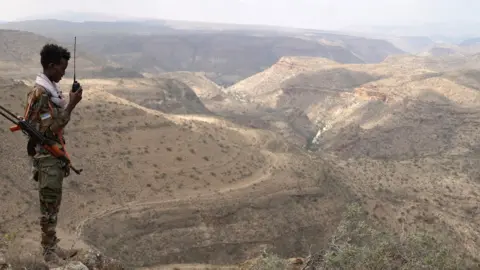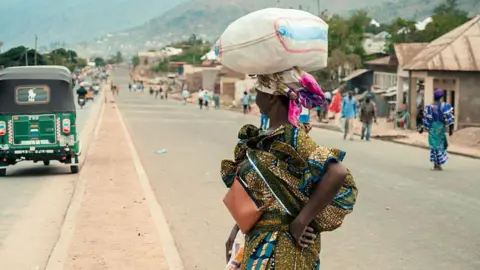
Rebel forces have entered the last government-held city in mineral-rich eastern Democratic Republic of Congo, in an offensive that has forced thousands to flee across the border into Burundi, residents say.
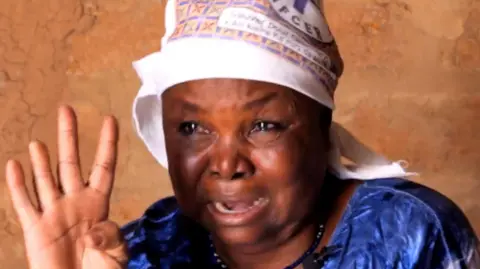
Heavy artillery and gunfire could be heard in Uvira, with terrified residents describing the situation as chaotic.
The escalation in fighting comes despite the peace deal brokered by US President Donald Trump last week between DR Congo's President Félix Tshisekedi and Rwanda's Paul Kagame to end the long-running conflict.
The M23 rebel group said it had liberated the city, while UN-backed Radio Okapi quoted residents as saying that rebel fighters were on major streets.
However, South Kivu Governor Jean-Jacques Purusi told local media that the army and allied militia remained in control of the city, which is just 27km (17 miles) from Burundi's capital, Bujumbura, across Lake Tanganyika.
Burundi has shut its border with DR Congo, a Burundian military source was quoted as saying by AFP news agency.
One resident told the BBC that armed M23 fighters had marched in a single column into Uvira from the north-east on Wednesday, meeting no resistance.
Some residents cheered their arrival, the resident said.
The city was in lockdown, with shops and schools closed as most people stayed indoors.
Three bombs have just exploded in the hills. It's every man for himself, one resident told AFP, while another added: We are all under the beds in Uvira - that's the reality.
A local rights official told AP news agency that there was a risk of a massacre if the remaining soldiers mounted strong resistance.
It's chaotic, nobody's in charge. Uvira is done for, a Burundian officer told AFP.
Military and security sources said the rebel fighters advanced from the north, near the Burundian border.
Burundi has several thousand troops in eastern DR Congo in support of the government. Its leader Évariste Ndayishimiye flew to Washington last week to observe the signing of the peace accord that Trump hailed as a miracle.
On Tuesday, the US, European Union, and eight European nations accused Rwanda of supporting the rebel offensive, and called for an immediate halt to the fighting.
In a joint statement, they voiced profound concern about the violence, and said it had a destabilising potential for the whole region.
They urged the Rwanda Defence Force (RDF) to immediately halt offensive operations in eastern DR Congo, and called on its troops to withdraw from the region.
A spokesman for the US state department said that Rwanda continues to provide support to M23 [and] must prevent further escalation.
But Rwanda has denied any involvement in the fighting, accusing DR Congo's government and its ally, Burundi, of violating a ceasefire.
In a statement on X, the Rwandan foreign ministry said the ceasefire violation cannot be placed on Rwanda and said the Congolese and Burundian armies had systematically bombed villages close to Rwanda's border.
UN experts say Rwanda's army is in de facto control of M23 operations.
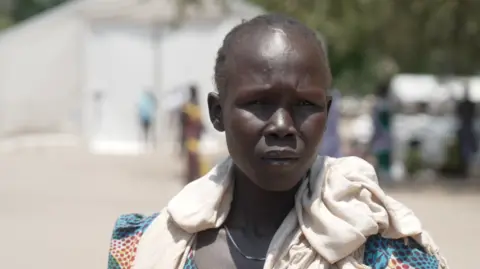
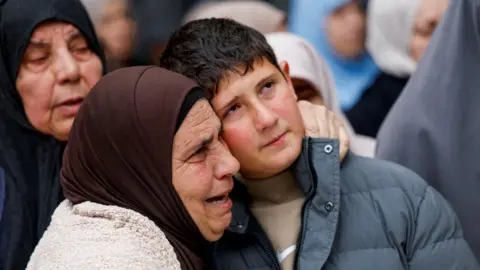
About 200,000 people have fled their homes in eastern DR Congo since the latest round of fighting started early this month, the UN says.
It said at least 74 people had been killed, mostly civilians, and 83 admitted to hospital with wounds.
A Burundian administrative source told AFP that he had recorded more than 8,000 daily arrivals over the past two days, and 30,000 arrivals in one week.
The latest offensive comes nearly a year after the M23 rebels seized control of Goma and Bukavu, the other two main cities in eastern DR Congo.
The M23 is not part of the US-brokered peace deal, and is in separate talks with DR Congo's government in mediation efforts led by Qatar.
In a national address on Monday, Tshisekedi accused Rwanda of deliberate violations of the peace accord.
This is a proxy war aimed at challenging our sovereignty over a highly strategic area, rich in critical minerals and economic potential that is crucial to the future of our nation, Tshisekedi said.
For its part, Rwanda accused the armies of DR Congo and Burundi of bombing villages near its border, forcing more than 1,000 civilians to flee into its territory.
Eastern DR Congo has been wracked by conflict for more than 30 years, since the 1994 Rwandan genocide. Several peace deals going back to the 1990s have collapsed.
Numerous armed groups have competed with the central authorities for power and control of the potential fortune in this vast nation.