Residents in Thailand's Ban Thanon Khot are accustomed to the rumbling of trains – rail is a key mode of transportation connecting the remote town with major cities.
But on Wednesday, the mundane rhythm ended in tragedy.
The noise was abnormally loud. A huge, crashing sound, said school volunteer Pitchaya Promenade. I saw a blue crane sliding. It seemed stuck for a moment, and suddenly it flipped over.
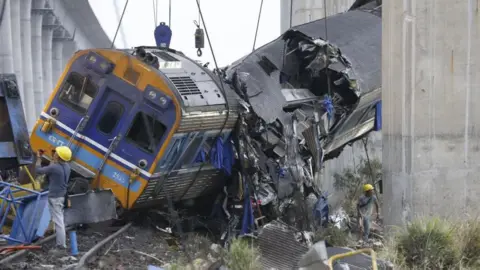
The construction crane had collapsed onto a moving train, killing at least 32 people and injuring 66 others. Most were students and workers travelling for school and work. Thailand's Public Health Ministry said there were still three people missing from the accident.
Rescuers were still pulling bodies out of the mangled train when the BBC arrived at the scene in the evening. Parts of it were completely crushed.
If I had to describe the damage visually, it looked like a spoon scooping into a slice of cake, said Pitchaya, 32, who is trained in basic first aid and was able to attend to some of those wounded.
There was an elderly woman hanging upside down [from a carriage]... Another woman, whose right arm appeared to be broken, was holding onto her.
One of the train carriages had caught fire from the collision, which further complicated rescue efforts. Emergency responders used cranes and hydraulic cutting tools to free passengers trapped in the wreckage.
People were screaming 'Help! Help!' and smoke was starting to rise, said restaurant owner Penporn Pumjantuek, who works about 100m from the scene. Oil from the train was spilling everywhere.
She recalls being torn between fear and courage. I'm still scared when I think about it. I still remember that moment, running in to help them, when there was no one else there yet. They were crying. It was terrifying.
A one-year-old and an 85-year-old were among those injured, with seven people in critical condition, authorities said on Wednesday.
The crane involved in the accident was being used to build an overhead railway that is part of a US$5.4bn (£4bn) China-backed project to link Bangkok with southwestern China via Laos.
Many questions remain unanswered.
Thai Prime Minister Anutin Charnvirakul has called for an investigation, while the State Railway of Thailand has said it is suing the Italian-Thai Development Company - the firm in charge of the section of the railway where the incident took place.
The same company was responsible for the construction of a Bangkok skyscraper that collapsed last March during an earthquake, when no other buildings in the city fell.
Amorn Pimanmas, an engineering professor at Bangkok's Kasetsart University, believes that human, rather than natural, factors are the more likely cause of Wednesday's tragedy.
Given that there were no storms, no flooding, and no significant vibration from the train passing underneath, natural causes can almost entirely be ruled out as the origin of the incident, Amorn said.
Thailand is no stranger to deadly construction accidents, due in part to weak enforcement of safety standards and regulations.