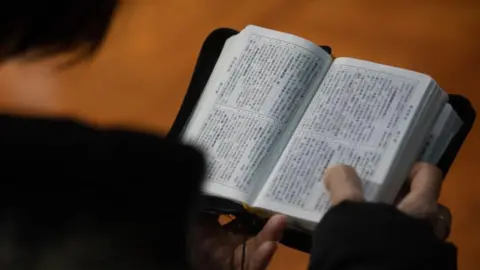
An influential Protestant church in China, the Early Rain Covenant Church, has reported the arrest of several prominent leaders in what appears to be an escalating crackdown on the underground church movement.
On Tuesday, nine individuals were detained following police raids on their homes and the church office in Chengdu. Out of those, five individuals had been released by Wednesday.
Simultaneously, over 1,000 miles away in Wenzhou, local authorities began demolishing the Yayang Church building. Video footage obtained by the non-profit organization ChinaAid, which monitors religious persecution, captures the ongoing destruction.
This latest series of arrests reflects the Communist Party's determination to eradicate churches that do not conform to its ideology, according to Christian organizations.
In response to these actions, the BBC has reached out to China's embassy in the UK for comment. Thus far, authorities have not issued any statements regarding the arrests or the demolition actions concerning Yayang Church.
China's government promotes atheism and maintains strict control over religious practices. In 2018, authorities claimed there were approximately 44 million Christians in the country; however, it remains unclear if this count includes members of underground congregations.
The Communist Party has consistently pressured Christians to align with state-sanctioned churches under government-approved leaders. However, many Christian groups observe that recent months have seen a marked increase in the speed and frequency of arrests.
At least two church leaders have indicated to the BBC that authorities are now swiftly detaining unauthorized church leaders, a notable shift from past practices which typically involved warning, fining, and then arresting non-compliant individuals.
Li Yingqiang, the current leader of the Early Rain Covenant Church, had previously expressed concerns about an impending storm of government crackdowns, advising church members to prepare for challenging times.
The church issued a statement that they regard this as a 'concerted operation,' but they are still unclear about the specific legal grounds for the arrests or if any formal charges have been made.
In Wenzhou, reports indicate that hundreds of armed and special police officers have been deployed to oversee the demolition operation of Yayang Church.
Wenzhou, sometimes referred to as “the Jerusalem of China,” is noted for having a significant Christian population. Reports suggest that local residents near Yayang Church have been forcibly relocated and access to the area has been restricted for those working nearby.
Bob Fu, founder of ChinaAid, emphasized that the government’s mobilization against significant independent church networks signals a firm resolve to eliminate Christian congregations that do not adhere closely to communist doctrine.
In December, around 100 members of Yayang Church were arrested over a span of five days, with at least 24 individuals reportedly still in custody.
The Chinese government has exhibited a longstanding pattern of targeting the Early Rain Covenant Church, particularly following a major raid in 2018 that led to the arrest of founding pastor Wang Yi and his wife, along with numerous congregants.
Wang Yi, a vocal critic of the Communist Party’s religious policies, is presently serving a lengthy prison sentence for 'inciting subversion of state power.' Despite the challenges, the church has continued to operate online, sometimes sharing recorded sermons from Wang with members.
Human Rights Watch's China researcher, Yalkun Uluyol, argued that the Xi administration's tightening of ideological control has fostered an environment hostile to any allegiance that surpasses loyalty to the Communist Party. Calls are being made for international leaders and organizations to advocate for the release of detained religious adherents and uphold religious freedoms in China.
Under Xi Jinping, the Chinese government has heightened its regulation of religious practice, frequently mandating that religious beliefs conform to traditional Chinese culture and values.
Measures implemented last year included a ban on clergy preaching through live social media, organizing online activities targeted at children, and raising funds via online platforms unless conducted through government-sanctioned channels.