The last nuclear weapons control treaty between the US and Russia is due to expire on Thursday, raising fears of a new arms race.
The Strategic Arms Reduction Treaty, known as New START and signed in 2010, was one of a handful of agreements designed to help prevent a catastrophic nuclear war.
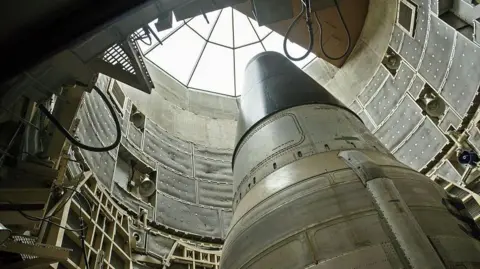
The treaty capped the number of deployed strategic nuclear warheads for each party to 1,550. It also established transparency measures, including data transfer, notifications, and on-site inspections.
Its expiration effectively marks an end to arms control cooperation between Washington and Moscow that helped bring an end to the Cold War.
On Wednesday, Pope Leo urged the US and Russia to renew the treaty, saying the current global situation called for doing everything possible to avert a new arms race.
The original START treaty, signed in 1991, limited both parties to 6,000 nuclear warheads. New START was its successor, signed in 2010 by the US and Russia, the successor state to the dissolved Soviet Union.
Although Russia suspended the treaty three years ago amid tensions over the Ukraine war, both countries were still thought to be adhering to it.
The agreement prevented the uncontrolled build-up of nuclear weapons while providing the two nations with transparency measures to avoid misjudging each other's intentions.
The expiry follows a worrying trend, as other long-standing arms control treaties have also fallen by the wayside, including the Intermediate-Range Nuclear Forces Agreement and the Open Skies Treaty.
Britain's former head of the armed forces, Admiral Sir Tony Radakin, warned that the frameworks that kept global security could be unraveling, labeling the collapse of key arms control treaties as one of the most dangerous aspects of our current global security.
Recent comments from Russian politician Dmitry Medvedev, who signed the New START treaty, termed its expiration as alarming. Meanwhile, a senior adviser to Russian President Vladimir Putin indicated a calm approach post-treaty expiration.
US President Donald Trump remarked that if the treaty expired, the US would seek to forge a better agreement and noted that future arms control should include China, which is expanding its nuclear arsenal.
Experts express concerns over the evolving nuclear capabilities of both nations, suggesting the possibility of a new arms race fueled by modernization efforts, and highlighting that the expired treaty's absence may complicate future arms control negotiations.