Silva Gu's eyes dart back and forth across miles of tall grassland, scouring it for signs of life in the darkness. He speaks in less than a whisper as we try to find a spot to hide in the fields. Behind us, the vast metropolis of Beijing has yet to wake. As we wait, we hear only our own breath.
Then, as the sky starts to lighten ahead of sunrise, we hear footsteps. The poachers are here.
Slim and stealthy, Silva heads out first. We eventually follow with our cameras. Slowly, we tread through a line of trees, into a small clearing. We only spot the bird net when it is a few inches from our faces.
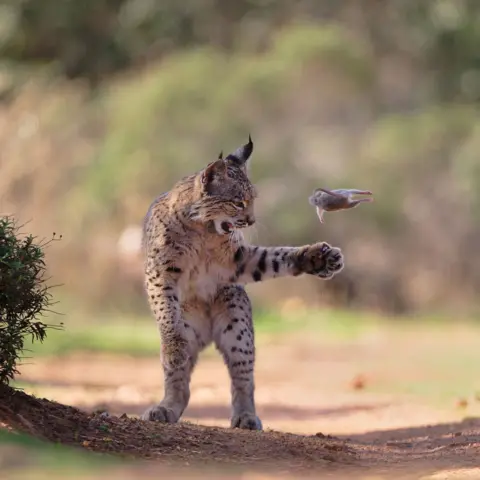
Each year, tens of thousands of birds are caught in nets across China for the pet trade or for meat. The pandemic and a property crisis have turned the economy sluggish - so catching and selling songbirds on the black market is a low-cost and often low-risk way of making a large profit.
A pretty songbird, such as a Siberian rubythroat, can often sell for nearly 2,000 yuan (£210; $280), which is more than many farmers earn in a month.
'I want to protect them on this Earth controlled by humans, says Silva, whose passion for birds drives his efforts.
In the skies above us, billions of birds, many so small that they can fit in the palm of your hand, are migrating south for winter. They take advantage of long summer days in Siberia and Mongolia, feasting on bugs and berries. China is home to over 1,500 bird species, about 13% of the global population.
But the patch of grassland where we were is an oasis for small birds - an area where both the birds and the poachers find refuge.
Determined to address this issue, Silva, in his 30s, uses his own savings to work full-time for conservation. He has led efforts to educate police and recruit volunteers against poaching. However, enforcing wildlife protection laws remains a challenge.
As Silva manages to intercept one poacher, the struggles and complexities of wildlife protection in urbanized China unfold. The legacy of keeping caged birds as status symbols complicates the fight, as many affluent individuals participate in the trade without realizing the impact on bird populations.
Despite the overwhelming odds, Silva continues to patrol the grasslands, driven by hope for a future in which China's songbirds can return to their natural habitat and bring their songs back to the skies of Beijing.
Then, as the sky starts to lighten ahead of sunrise, we hear footsteps. The poachers are here.
Slim and stealthy, Silva heads out first. We eventually follow with our cameras. Slowly, we tread through a line of trees, into a small clearing. We only spot the bird net when it is a few inches from our faces.
Each year, tens of thousands of birds are caught in nets across China for the pet trade or for meat. The pandemic and a property crisis have turned the economy sluggish - so catching and selling songbirds on the black market is a low-cost and often low-risk way of making a large profit.
A pretty songbird, such as a Siberian rubythroat, can often sell for nearly 2,000 yuan (£210; $280), which is more than many farmers earn in a month.
'I want to protect them on this Earth controlled by humans, says Silva, whose passion for birds drives his efforts.
In the skies above us, billions of birds, many so small that they can fit in the palm of your hand, are migrating south for winter. They take advantage of long summer days in Siberia and Mongolia, feasting on bugs and berries. China is home to over 1,500 bird species, about 13% of the global population.
But the patch of grassland where we were is an oasis for small birds - an area where both the birds and the poachers find refuge.
Determined to address this issue, Silva, in his 30s, uses his own savings to work full-time for conservation. He has led efforts to educate police and recruit volunteers against poaching. However, enforcing wildlife protection laws remains a challenge.
As Silva manages to intercept one poacher, the struggles and complexities of wildlife protection in urbanized China unfold. The legacy of keeping caged birds as status symbols complicates the fight, as many affluent individuals participate in the trade without realizing the impact on bird populations.
Despite the overwhelming odds, Silva continues to patrol the grasslands, driven by hope for a future in which China's songbirds can return to their natural habitat and bring their songs back to the skies of Beijing.