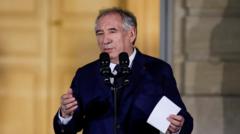
His appointment signals Macron's intention to stabilize his administration after the ousting of his predecessor just nine days earlier. The new prime minister's challenge involves not only managing budgetary pressures—currently projected to maintain a deficit at 6.1% of GDP—but also building a coalition that can weather the political storms brewing in the National Assembly. Ahead of Bayrou's arrival at the Hôtel Matignon, Michel Barnier had been dismissed following a contentious budget proposal that drew ire from both left and right political factions.
Bayrou, seen as a potential consensus builder, faces considerable scrutiny as opinion polls indicate widespread anxiety about the current political landscape in France, with 61% of voters expressing concern. His first task will be to form a stable government while navigating discontent from the far-left France Unbowed party, which has already threatened to call for a vote of no confidence.
President Macron, who remains determined to serve out his second term until 2027, had engaged in negotiations with multiple parties—excluding the far-right and far-left—prior to naming Bayrou. The political landscape remains fragmented, with an uneasy truce among center-left factions, all while the far-right National Rally views Bayrou’s appointment with cautious optimism, urging for dialogue on pressing issues like the cost of living.
As Bayrou settles into his new position, the eyes of the nation remain focused on whether he can bridge the widening political gaps and fulfill the tough promises he has articulated.
Bayrou, seen as a potential consensus builder, faces considerable scrutiny as opinion polls indicate widespread anxiety about the current political landscape in France, with 61% of voters expressing concern. His first task will be to form a stable government while navigating discontent from the far-left France Unbowed party, which has already threatened to call for a vote of no confidence.
President Macron, who remains determined to serve out his second term until 2027, had engaged in negotiations with multiple parties—excluding the far-right and far-left—prior to naming Bayrou. The political landscape remains fragmented, with an uneasy truce among center-left factions, all while the far-right National Rally views Bayrou’s appointment with cautious optimism, urging for dialogue on pressing issues like the cost of living.
As Bayrou settles into his new position, the eyes of the nation remain focused on whether he can bridge the widening political gaps and fulfill the tough promises he has articulated.