Eduardo Morán, a doctor at Córdoba's Reina Sofía Hospital, suspected it was serious. He and his wife, also a medic, had been asked to head to work after reports that two high-speed trains had collided nearby. 'We were preparing different parts of the hospital,' he recalls. 'Not just the emergency room, but the intensive care unit, all the surgery theatres and the regular floor. Everybody was there.' As the patients arrived, their injuries ranged from scratches to missing limbs. Staff prioritized who to treat. Some were operated on, others monitored. Eduardo had never seen such an influx of casualties in his 20-year career, and yet the hospital was not overwhelmed. 'We were expecting more,' he says. 'Unfortunately, there were a lot of people who didn't make it and died on the railway.'
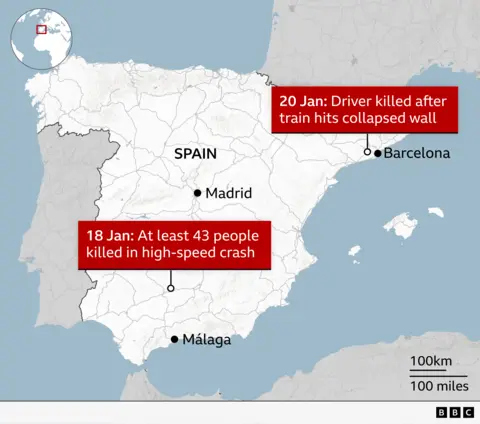
In dense woodland 36 miles from Córdoba lies the tangled wreckage of the two trains that collided on Sunday evening. A gap in the straight section of track is thought to be what investigators are focusing on. At least 43 people lost their lives here, and as sniffer dogs weave between the empty seats and shattered windows, there is still a hunger to unearth answers as to what caused Spain's worst rail crash in more than a decade.
Authorities have called for patience as a need for extensive investigations prolongs the search for clarity. Meanwhile, a strike has been called by the train drivers' union in response to ongoing rail safety concerns. For the families of the victims, every passing moment deepens their despair, as they grapple with the loss of loved ones.
Throughout Saturday afternoon and into the night in Córdoba, Jose Manuel Muñoz and his friends were holding a surprise 50th birthday party for María del Carmen Abril, a teacher. The party was barely over when Abril made her way back north to Madrid. She was one of the unfortunate souls confirmed dead as the trains collided. Her friend, Muñoz, describes the tragic shift from celebration to grief, underscoring the random nature of fate in moments like these.
As families seek closure and answers, the Spanish rail system finds itself under scrutiny in the wake of this catastrophe.
In dense woodland 36 miles from Córdoba lies the tangled wreckage of the two trains that collided on Sunday evening. A gap in the straight section of track is thought to be what investigators are focusing on. At least 43 people lost their lives here, and as sniffer dogs weave between the empty seats and shattered windows, there is still a hunger to unearth answers as to what caused Spain's worst rail crash in more than a decade.
Authorities have called for patience as a need for extensive investigations prolongs the search for clarity. Meanwhile, a strike has been called by the train drivers' union in response to ongoing rail safety concerns. For the families of the victims, every passing moment deepens their despair, as they grapple with the loss of loved ones.
Throughout Saturday afternoon and into the night in Córdoba, Jose Manuel Muñoz and his friends were holding a surprise 50th birthday party for María del Carmen Abril, a teacher. The party was barely over when Abril made her way back north to Madrid. She was one of the unfortunate souls confirmed dead as the trains collided. Her friend, Muñoz, describes the tragic shift from celebration to grief, underscoring the random nature of fate in moments like these.
As families seek closure and answers, the Spanish rail system finds itself under scrutiny in the wake of this catastrophe.