Spain's Roman Catholic Church has reached an agreement with the government to compensate victims of sexual abuse by members of the clergy.
The accord follows complaints that religious leaders had failed to tackle the issue adequately.
It means the government will manage possible compensation in co-ordination with the Church, handling cases where other legal avenues are no longer available because the alleged crime took place too long ago or the individual accused has passed away.
Hundreds of thousands of Spaniards are estimated by the government to have suffered sexual abuse at the hands of Church figures. The move follows similar redress schemes in other nations where abuse has been uncovered.
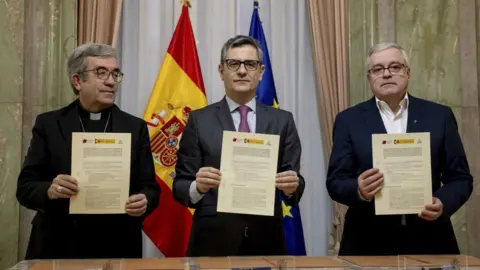
Justice Minister Félix Bolaños emphasized the moral necessity of compensating victims, stating, A democracy should not allow the existence of victims who have never been compensated [and] whose situation, on the contrary, had been covered up.
The agreement sought to address a historic, moral debt the state had with the victims of abuse.
Other key figures involved in the signing were Luis Argüello, President of the Episcopal Conference, and Jesús Díaz Sariego, President of the Conference of Religious.
Bolaños noted that this initiative was unprecedented by addressing crimes that had passed the statute of limitations.
A study by the Spanish ombudsman's office estimated that around 1.1% of the Spanish population, approximately 440,000 individuals, had experienced sexual abuse related to Church figures.
Although the Church contested these findings, it has initiated a separate reparations scheme, which critics argue lacked transparency and external oversight.
The new process allows victims to submit cases to a new agency set up by the justice ministry, which will then forward the cases to the ombudsman to propose reparations that the Church will need to approve.
The terms of compensation can include symbolic, psychological, or financial aspects, though no specific amount has been indicated as yet.
Critically, the Church has faced a growing call for accountability, following revelations of abuse across the globe, and now within Spain as media investigations have uncovered numerous cases.
Victims' groups have welcomed this agreement, viewing it as a significant step towards addressing the structural problems within the Church regarding abuse and reparations.