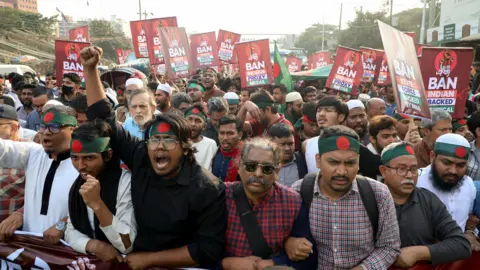
As political tensions rise in Bangladesh with the imminent elections, many young people are expressing a growing anti-Indian sentiment. Since the overthrow of former Prime Minister Sheikh Hasina, who is currently in exile in India, the youth have turned their frustrations toward India's perceived influence in Bangladeshi politics.
The walls of Dhaka University are adorned with graffiti echoing the political sentiments of the youth, who draw on the recent July 2024 uprising that led to Hasina’s fall after a controversial reign marred by accusations of autocracy. Now, with the first real election on the horizon, the atmosphere is charged with debates among students regarding their government and its relationship with India.
Supporters of Hasina's Awami League party find themselves sidelined as opposition parties, notably the Bangladesh Nationalist Party (BNP), prepare to fill the political void left by their absence amid rising Islamist sentiments.
Echoing these sentiments, students like Mosharraf Hossain express deep-seated grievances against what they perceive as Indian interference in Bangladesh’s democratic processes. Most notably, the rise in anti-Indian sentiment is linked to India's endorsement of Hasina's controversial policies, particularly during elections in which democracy was perceived to be under attack.
The slogan ‘Dhaka, not Delhi’ has become emblematic of this sentiment, signifying a strong desire for national pride and sovereignty amongst the youth. As bilateral relations hit new lows, local media reports describe India as an overbearing neighbor, further amplifying frustrations over issues such as border killings and water-sharing disputes.
Despite recent efforts by Indian officials to mend ties, such as attending significant events in Bangladesh, many remain skeptical. Analysts note that the anger is not solely based on recent events but rather reflects a historical backdrop of perceived inequalities and disrespect in their diplomatic relationship.
Indications suggest that resolving these deep-seated issues between two neighboring countries rooted in shared history will require significant effort and a willingness to bridge the gap through respectful diplomacy. Yet, the road ahead appears complex and challenging amidst evolving political dynamics and shifting sentiments among Bangladesh's youth.
The walls of Dhaka University are adorned with graffiti echoing the political sentiments of the youth, who draw on the recent July 2024 uprising that led to Hasina’s fall after a controversial reign marred by accusations of autocracy. Now, with the first real election on the horizon, the atmosphere is charged with debates among students regarding their government and its relationship with India.
Supporters of Hasina's Awami League party find themselves sidelined as opposition parties, notably the Bangladesh Nationalist Party (BNP), prepare to fill the political void left by their absence amid rising Islamist sentiments.
Echoing these sentiments, students like Mosharraf Hossain express deep-seated grievances against what they perceive as Indian interference in Bangladesh’s democratic processes. Most notably, the rise in anti-Indian sentiment is linked to India's endorsement of Hasina's controversial policies, particularly during elections in which democracy was perceived to be under attack.
The slogan ‘Dhaka, not Delhi’ has become emblematic of this sentiment, signifying a strong desire for national pride and sovereignty amongst the youth. As bilateral relations hit new lows, local media reports describe India as an overbearing neighbor, further amplifying frustrations over issues such as border killings and water-sharing disputes.
Despite recent efforts by Indian officials to mend ties, such as attending significant events in Bangladesh, many remain skeptical. Analysts note that the anger is not solely based on recent events but rather reflects a historical backdrop of perceived inequalities and disrespect in their diplomatic relationship.
Indications suggest that resolving these deep-seated issues between two neighboring countries rooted in shared history will require significant effort and a willingness to bridge the gap through respectful diplomacy. Yet, the road ahead appears complex and challenging amidst evolving political dynamics and shifting sentiments among Bangladesh's youth.