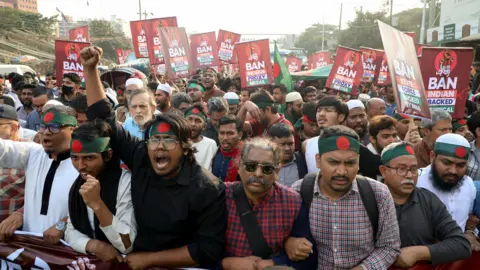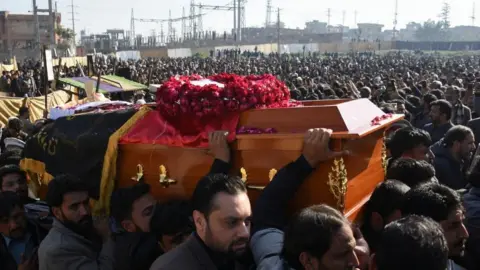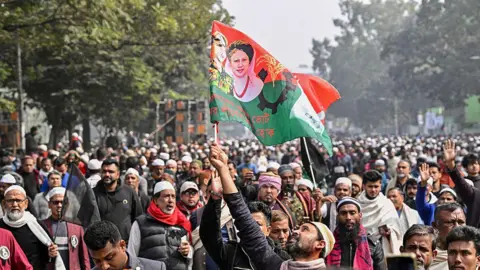
Hundreds of thousands of people travelled from across Bangladesh to the capital Dhaka on Wednesday to pay their final respects to former Prime Minister Khaleda Zia.
Zia, who was the country's first female prime minister, died on Tuesday from a prolonged illness. She was 80.
The mourners held out their hands in prayer and carried flags printed with her photographs as a motorcade carrying Zia's body - including the hearse wrapped with the national flag - drove on streets near the parliament house.
Flags were flown at half-mast and thousands of security officers were deployed.
'I have come this far just to say goodbye. I know I won't be able to see her face, but at least I could see the [vehicle] carrying her for the last rites,' Setara Sultana, an activist from Zia's Bangladesh Nationalist Party (BNP), told the BBC.
Sharmina Siraj, a mother of two, called Zia 'an inspiration', highlighting the stipends introduced by the former leader to improve women's education, which made a 'huge impact' on her daughters.
'It is difficult to imagine women in leadership positions anytime soon,' she told AFP news agency.
Foreign dignitaries including India's External Affairs Minister S Jaishankar attended the funeral.
Earlier in the day, Zia's body was taken to the house of her son Tarique Rahman, who was seen reciting the Quran beside his mother's office.
The state funeral marks the end of Zia's extraordinary journey, from a homemaker to the first female prime minister of Bangladesh.
Zia was buried next to her husband Ziaur Rahman, who was assassinated in 1981 while serving as president. She emerged as a leader who fought for democracy and endured political challenges during her career.
Despite health issues, Zia had expressed intentions to run for parliament in 2026, as her party eyes a return to power in the country, with her son expected to take on a leading role if they succeed.
Zia, who was the country's first female prime minister, died on Tuesday from a prolonged illness. She was 80.
The mourners held out their hands in prayer and carried flags printed with her photographs as a motorcade carrying Zia's body - including the hearse wrapped with the national flag - drove on streets near the parliament house.
Flags were flown at half-mast and thousands of security officers were deployed.
'I have come this far just to say goodbye. I know I won't be able to see her face, but at least I could see the [vehicle] carrying her for the last rites,' Setara Sultana, an activist from Zia's Bangladesh Nationalist Party (BNP), told the BBC.
Sharmina Siraj, a mother of two, called Zia 'an inspiration', highlighting the stipends introduced by the former leader to improve women's education, which made a 'huge impact' on her daughters.
'It is difficult to imagine women in leadership positions anytime soon,' she told AFP news agency.
Foreign dignitaries including India's External Affairs Minister S Jaishankar attended the funeral.
Earlier in the day, Zia's body was taken to the house of her son Tarique Rahman, who was seen reciting the Quran beside his mother's office.
The state funeral marks the end of Zia's extraordinary journey, from a homemaker to the first female prime minister of Bangladesh.
Zia was buried next to her husband Ziaur Rahman, who was assassinated in 1981 while serving as president. She emerged as a leader who fought for democracy and endured political challenges during her career.
Despite health issues, Zia had expressed intentions to run for parliament in 2026, as her party eyes a return to power in the country, with her son expected to take on a leading role if they succeed.