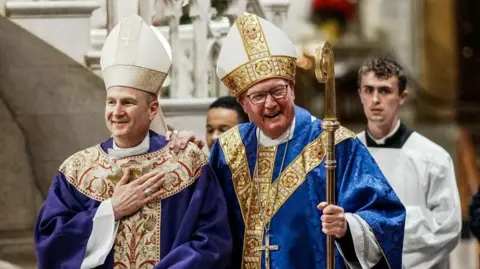
In a momentous first Mass held at the Sistine Chapel, Pope Leo XIV, the first American pontiff, delivered a poignant message directed at the heart of societal issues. Early on Friday, he pledged to prioritize the needs of "ordinary people," while reasserting the necessity for the Church to engage in "missionary outreach" to heal societal wounds. His vows come at a crucial juncture in the Roman Catholic Church's ongoing discourse on the balance between doctrine and compassion.
Pope Leo, originally known as Cardinal Robert Francis Prevost, framed a narrative rich with theological references that echoed the teachings of his predecessor, Pope Francis. He decried the growing distance between faith and contemporary society and noted, “a loss of religious faith has contributed to appalling violations of human dignity” across the globe. His words resonated deeply among the cardinals present, hinting at a dynamically evolving papacy focused on social justice.
The chosen pontiff emphasized the need for the Church to engage deeply with the faithful—to "build bridges" and advocate for the disenfranchised. He alluded to the struggles of Jesus, who found solidarity among the common people—yet lamented how even they often turned away during challenging times.
Michael Allen, a distinguished Vatican analyst, underscored the significance of Leo's mission-oriented approach, portraying him as a leader who "checked all the boxes" for cardinals seeking a continuation of Francis' legacy of reform. Leo's strong commitment to social justice and missionary work positions him as a voice for the marginalized amidst complex socio-political landscapes.
As the new pope steps into his role, he must soon address pressing matters, including the ongoing debates within the Church regarding inclusivity and engagement. His inaugural homily sets a tone of hope and expectation for a church prepared to confront rather than retreat from the challenges faced by society today.
Looking ahead, Pope Leo XIV's legacy will be shaped not only by theological considerations but also by his actions as he navigates the daunting task before him—ensuring that the Catholic Church answers the call of those eagerly awaiting support and solidarity in these uncertain times.